Customer Helpline:


What Size Commercial Refrigerated Display Cabinet Do You Need?
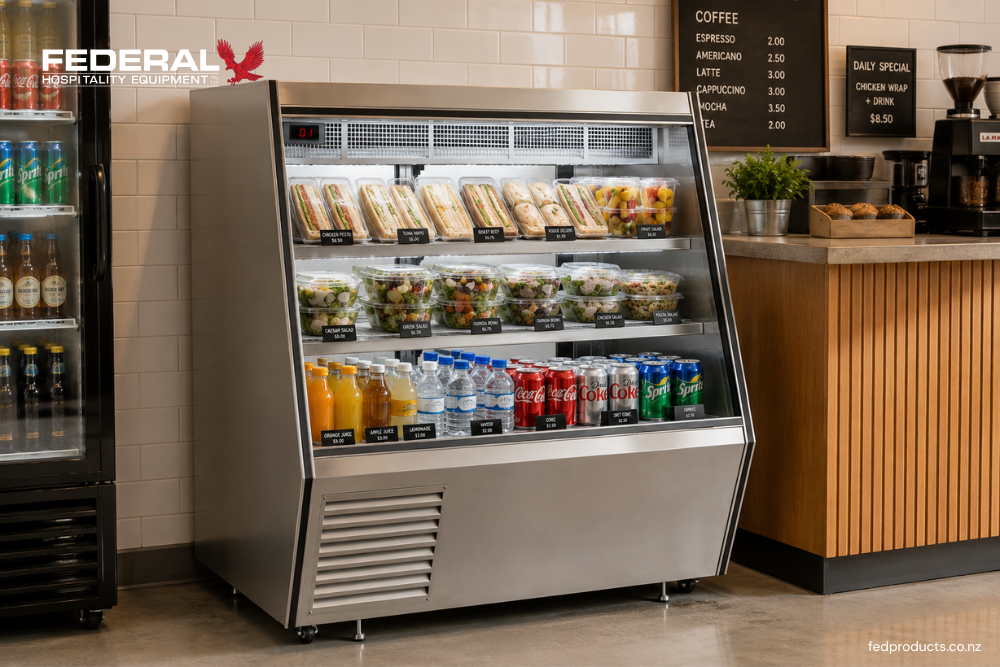
Selecting the right commercial refrigerated display cabinet is one of the most important purchasing decisions for any food service or retail business in New Zealand. Whether you operate a café in Auckland, a bakery in Christchurch, a convenience store in Hamilton, or a deli in Wellington, the size of your commercial refrigeration equipment directly influences how effectively you present products to customers.
The size of your chilled showcase affects product visibility, available floor space, energy consumption, operational efficiency, food safety, and long-term profitability. Choosing the correct capacity from the beginning helps businesses maximise product presentation, maintain safe storage conditions, and support future growth without unnecessary equipment upgrades.
Key Takeaways
| Key Factor | Why It Matters |
|---|---|
| Size according to peak demand | Always calculate capacity based on your busiest trading periods rather than average sales. |
| Internal capacity differs from external dimensions | A larger cabinet footprint does not always mean more usable presentation space. |
| Product size influences capacity | Cakes and platters require substantially more space than bottled drinks. |
| Energy efficiency affects operating costs | Cabinet size should balance display requirements with long-term electricity usage. |
| Plan for growth | Select a unit capable of handling at least 20% more than your current peak demand. |
Why Does Cabinet Size Matter?
A refrigerated display cabinet is not simply a storage solution. It acts as a sales presentation tool, showcasing products while maintaining safe chilled temperatures. The right size helps customers see your products clearly, gives staff enough room to replenish stock, and supports reliable temperature performance during busy service periods.
An undersized cabinet or gelato ice cream display limits product presentation during busy periods, while an oversized unit can occupy valuable retail space and consume more electricity than necessary. The ideal commercial chiller provides enough capacity to support current operations while leaving room for future expansion.
For businesses operating under the Australia New Zealand Food Standards Code, particularly Standard 3.2.2 relating to food safety practices and food premises, maintaining proper refrigerated storage and showcasing temperatures is essential. Choosing the right-sized refrigerated display cabinet for sale helps support consistent temperature control across all displayed products.
Business Impact of Correct Cabinet Sizing
| Business Area | Impact of Correct Sizing |
|---|---|
| Product presentation | Allows products to be displayed attractively without overcrowding. |
| Customer experience | Makes it easier for customers to view, compare, and select products. |
| Food safety | Supports consistent chilled storage temperatures. |
| Energy costs | Reduces unnecessary electricity use from oversized or overloaded units. |
| Retail space | Protects valuable floor space and avoids customer traffic bottlenecks. |
| Future growth | Gives the business room to increase product range or trading volume. |
What Is the Difference Between External Dimensions and Internal Capacity?
Many buyers focus solely on a cabinet's physical dimensions. However, understanding the difference between the external footprint and the internal usable volume is equally important.
External dimensions determine how much floor space the unit occupies. Internal capacity determines how many products can actually be showcased.
| Measurement | Definition | Importance |
|---|---|---|
| Width | Side-to-side measurement | Influences display frontage |
| Depth | Front-to-back measurement | Determines floor space required |
| Height | Floor-to-top measurement | Affects visibility and storage |
| Litre Capacity | Internal storage volume | Indicates product holding capacity |
| Usable Shelf Area | Actual display surface | Determines practical merchandising space |
Insulation thickness, evaporator placement, shelf design, and refrigeration components all reduce usable storage space. As a result, two cabinets with identical external dimensions can offer very different presentation capacities. For further information, visit the top refrigerated display cabinet suppliers and manufacturers in your area.
How Do You Calculate the Capacity You Need?
Capacity planning should begin with an assessment of both sales volume and product size. Rather than calculating average daily sales, base your requirements on your busiest trading periods. This approach ensures adequate stock presentation during seasonal spikes, weekends, public holidays, school holidays, and tourist surges.
As a general rule, select a refrigerated merchandising unit that accommodates at least 20% more than your current peak showcase requirement. This buffer helps prevent overcrowding and gives your business space to expand its product range.
Product Type and Space Requirement
| Product Type | Space Requirement |
|---|---|
| Bottled Drinks | Low |
| Packaged Sandwiches | Moderate |
| Deli Products | Moderate to High |
| Cakes and Desserts | High |
| Catering Platters | Very High |
A display chiller designed to hold 300 bottled beverages may accommodate far fewer cakes, platters, or prepared food trays. Always calculate based on product dimensions rather than product count alone.
Example Capacity Planning by Product Mix
| Business Type | Typical Display Requirement | Capacity Planning Advice |
|---|---|---|
| Café | Sandwiches, cakes, bottled drinks, salads | Choose flexible shelving that allows different product heights. |
| Bakery | Cakes, pastries, slices, desserts | Prioritise shelf spacing, visibility, and humidity-friendly refrigeration. |
| Deli | Cheese, meats, prepared salads, antipasto | Choose a cabinet with even cooling and easy staff access. |
| Convenience Store | Bottled drinks, packaged meals, snacks | Prioritise frontage, quick customer access, and energy efficiency. |
| Hotel Buffet | Platters, desserts, chilled breakfast items | Allow generous space for larger trays and frequent replenishment. |
How Much Floor Space Do You Actually Need?
Floor space planning involves two separate considerations: customer movement and staff workflow. Customer circulation should remain unobstructed, particularly in high-traffic environments such as cafés, bakeries, and convenience stores. When you buy a refrigerated display cabinet online, it should enhance product visibility without creating bottlenecks.
Staff workflow is equally important. Employees need adequate space to replenish stock, clean surfaces, and access service areas efficiently. Most manufacturers recommend maintaining a minimum ventilation clearance of approximately 10 centimetres around refrigeration equipment, such as deli display fridges and freezers. This clearance helps airflow around condensers and compressors, improving efficiency and reducing mechanical strain.
How Do You Measure Your Available Space Correctly?
Before purchasing a commercial deli fridge or chilled showcase, follow this simple measurement process. Taking accurate measurements before ordering can prevent delivery issues, installation delays, and layout problems.
| Step | By-Step Action |
|---|---|
| 1 | Measure the installation width, depth, and height. |
| 2 | Check nearby doorways and delivery access points. |
| 3 | Allow at least 10 cm clearance for ventilation. |
| 4 | Measure customer walkways and queueing areas. |
| 5 | Verify access for cleaning and maintenance. |
| 6 | Confirm power outlet locations and electrical requirements. |
This process prevents installation challenges and ensures the cabinet integrates smoothly into daily operations.
Should You Choose an Open-Front or Glass-Door Cabinet?
Both alternatives carry benefits depending on your business model. Open-front displays are commonly used in fast grab-and-go environments, while glass-door models are often chosen for better temperature retention and lower operating costs.
| Feature | Open Front Display | Glass Door Display |
|---|---|---|
| Customer Access | Excellent | Good |
| Product Visibility | Excellent | Very Good |
| Energy Efficiency | Lower | Higher |
| Temperature Retention | Moderate | Excellent |
| Product Capacity | Moderate | High |
| Operating Costs | Higher | Lower |
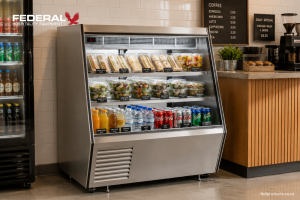
Open-front refrigerated display cabinets in New Zealand work well in grab-and-go environments where convenience is the priority. Glass-door refrigerated display variants usually provide superior temperature stability and reduced power usage.
How Does Cabinet Size Affect Energy Efficiency?
Larger refrigeration units require more power to maintain consistent temperatures because they cool a greater internal volume. However, oversizing is not the only concern. Overloading a cabinet can restrict airflow, forcing compressors to work harder and reducing efficiency.
Modern commercial refrigeration systems increasingly use HC (Hydrocarbon) refrigerants, high-performance insulation, electronically controlled compressors, and LED (Light Emitting Diode) lighting to reduce operating costs. When comparing models, evaluate annual energy consumption alongside display capacity.
The most cost-effective solution is not always the smallest unit, but the cabinet that balances storage requirements with efficient operation.
Energy Efficiency Factors to Compare
| Feature | Why It Matters |
|---|---|
| LED lighting | Improves product visibility while using less energy than older lighting. |
| High-performance insulation | Helps maintain cabinet temperature with less compressor strain. |
| Glass doors | Improve temperature retention compared with open-front designs. |
| Efficient compressors | Support lower running costs and more stable cooling. |
| Correct cabinet size | Prevents wasted energy from oversized units or overloaded displays. |
Recommended Cabinet Sizes by Business Type
The following guidelines provide a useful starting point for most New Zealand businesses. Actual requirements should always be confirmed based on product dimensions, trading volume, cabinet layout, and available floor space.
| Business Type | Recommended Capacity |
|---|---|
| Small Café | 300–500 litres |
| Bakery | 500–900 litres |
| Deli | 600–1200 litres |
| Hotel Buffet Area | 800–1200 litres |
| Convenience Store | 800–1500 litres |
| Supermarket | 1500 litres and above |
Actual requirements for products supplied by leading refrigerated display cabinet dealers and distributors should always be based on product range, peak trading volumes, and available floor space.
Common Mistakes When Choosing a Refrigerated Display Cabinet Size
| Common Mistake | Potential Problem | Better Approach |
|---|---|---|
| Choosing based only on external dimensions | The cabinet may fit the space but provide insufficient usable shelf area. | Compare internal capacity and practical product layout. |
| Calculating based on average sales | The cabinet may be too small during weekends or peak trading periods. | Base sizing on peak demand plus a growth buffer. |
| Ignoring ventilation clearance | Poor airflow can increase energy use and mechanical strain. | Allow at least 10 cm clearance where required. |
| Overloading shelves | Restricted airflow may reduce cooling performance. | Leave enough space for proper air circulation. |
| Buying too large too early | Higher electricity use and wasted retail space. | Choose capacity that balances demand, growth, and efficiency. |
Buyer Checklist Before Purchasing
- Measure installation width, depth, and height.
- Check doorway and delivery access.
- Calculate capacity based on peak trading periods.
- Add at least 20% growth allowance where practical.
- Measure actual product dimensions, not just product count.
- Compare usable shelf area, not only litre capacity.
- Allow ventilation clearance around refrigeration components.
- Confirm staff access for cleaning and restocking.
- Check customer walkway and queue space.
- Compare open-front and glass-door options.
- Review energy consumption and operating costs.
- Confirm electrical requirements before ordering.
Conclusion
Choosing the correct size commercial refrigerated display cabinet requires balancing capacity, floor space, energy efficiency, and long-term business goals. Whether you are investing in a chilled showcase, commercial deli fridge, sushi display cabinet, or refrigerated merchandising unit, sizing decisions should always be based on peak demand rather than average sales.
Understanding the difference between external dimensions and usable display capacity allows businesses to make more informed purchasing decisions. Factoring in product size, ventilation requirements, shelf configuration, seasonal demand, and future growth ensures the equipment continues to deliver value for many years.
For New Zealand cafés, bakeries, delis, convenience stores, supermarkets, and hospitality venues, the right display cabinet size can improve product presentation, protect food quality, reduce energy waste, and support a better customer experience.
FAQs: Commercial Refrigerated Display Cabinet Sizing
1. How do I know what size refrigerated display cabinet I need?
Start by measuring your available floor space, calculating your busiest trading-period stock requirement, and checking the size of the products you plan to display. Add around 20% extra capacity where practical to allow for growth.
2. Is litre capacity the most important measurement?
No. Litre capacity is useful, but usable shelf area is often more important for product presentation. Two cabinets with similar litre capacity may offer different practical display space.
3. Should I choose a bigger cabinet for future growth?
Yes, but only within reason. A modest growth allowance can prevent early replacement, while an oversized cabinet may waste floor space and increase electricity costs.
4. Are open-front cabinets less energy efficient?
Generally, yes. Open-front refrigerated cabinets provide easy customer access but usually have lower temperature retention and higher operating costs than glass-door models.
5. How much ventilation clearance does a refrigerated display cabinet need?
Many manufacturers recommend around 10 cm of ventilation clearance near refrigeration components, although the exact requirement should be confirmed with the supplier or manufacturer.
6. What size cabinet is suitable for a small café?
A small café may typically require a 300–500 litre cabinet, depending on product range, customer traffic, available space, and peak trading demand.
-
 Bonvue Chilled Food Display - SG120FA-2XBSpecial Price NZ$3,134.45 (Excl. GST) Regular Price NZ$5,699.00 (Excl. GST)
 -
 Bonvue Chilled Food Display - SG180FA-2XBSpecial Price NZ$3,904.45 (Excl. GST) Regular Price NZ$7,099.00 (Excl. GST)
 -

-

-