Customer Helpline:


Why Stainless Steel Undershelves Are a Standard Component in New Zealand Hospitality Kitchens?

New Zealand’s hospitality industry operates in an environment where speed, hygiene, and efficient kitchen organisation directly affect service quality and regulatory compliance. From high-capacity Auckland cafés and Wellington eateries to Queenstown establishments and Christchurch hospitality businesses, commercial kitchens must handle consistent workflow pressure while following strict cleanliness benchmarks.
At the same time, many hospitality operators face rising rental costs, labour shortages, and tighter food safety expectations under guidelines monitored by the Ministry for Primary Industries (MPI). These operational pressures have increased demand for practical kitchen infrastructure that improves workflow without consuming additional floor space.
One storage solution increasingly adopted across New Zealand hospitality venues is the stainless steel undershelf. Rather than functioning as a simple add-on, under-bench shelving has become a standard component for modern kitchen compliance, organisation, and operational efficiency.
Key Takeaways
| Core Benefit | Why It Matters in NZ Hospitality Kitchens |
|---|---|
| Hygiene Compliance | Helps kitchens align with MPI food safety expectations and HACCP (Hazard Analysis Critical Control Point) procedures |
| Space Maximisation | Converts unused space beneath prep benches into accessible storage |
| Long-Term Durability | 304 Grade stainless steel resists corrosion, moisture, and heavy daily usage |
Why Is Stainless Steel Preferred in Hospitality Kitchens?
The table below compares common hospitality shelving materials.
| Feature | Stainless Steel Undershelves | Wooden Shelves | Plastic Shelving |
|---|---|---|---|
| Moisture Resistance | Excellent | Poor | Moderate |
| Hygiene Performance | Very High | Low | Moderate |
| Durability | Long-lasting | Can warp or crack | Can bend under weight |
| Ease of Cleaning | Very Easy | Difficult | Easy |
| Heat Resistance | Excellent | Poor | Limited |
| Commercial Suitability | Ideal | Limited | Moderate |
| Corrosion Resistance | High | Low | Moderate |
For catering operators looking to maintain long-term sanitation benchmarks, a stainless steel undershelf for sale provides a more robust and hygienic storage solution.
How Do Undershelves Save Space in Smaller NZ Kitchens?
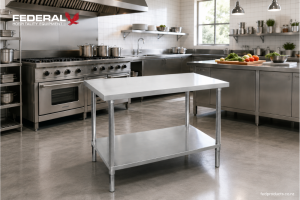
Products like undershelves and overshelves double your usable counter space by converting the idle space beneath tables into properly arranged storage. Space limitations are common in Auckland and Wellington hospitality venues, where commercial rents remain high. Smaller kitchens must still support fast-moving breakfast, lunch, and dinner services without creating staff congestion.
Prep table base-shelves help kitchens maximise vertical storage while keeping essential tools within immediate reach. Instead of installing bulky cupboards that restrict airflow and movement, operators can use open lower-tier storage solutions to maintain accessibility and workflow visibility.
The table below shows how these storage systems improve efficiency in compact hospitality kitchens.
| Kitchen Challenge | How Undershelves Improve Efficiency |
|---|---|
| Limited storage space | Creates usable storage beneath workstations |
| Cluttered preparation areas | Keeps tools and supplies organised |
| Slow kitchen workflow | Improves accessibility during service |
| Staff congestion | Reduces unnecessary movement |
| Poor kitchen layout | Supports better workstation flow |
| Hygiene concerns | Keeps equipment elevated from the floor |
What Does a Typical Café Workflow Look Like With Undershelves?
Without Under-Bench Storage
A café worker preparing coffees and cabinet food repeatedly walks across the kitchen to retrieve trays, takeaway packaging, and ingredient containers stored in separate cupboards. This increases service delays and creates unnecessary staff movement during peak hours. For further information, visit the top undershelf suppliers and manufacturers near you.
With Integrated Kitchen Shelving
The same worker accesses milk crates, takeaway lids, cleaning cloths, and backup ingredients directly beneath the prep station. Orders move faster, preparation zones stay cleaner, and workflow interruptions decrease significantly.
In high-volume hospitality environments, reducing even a few seconds of movement per task can improve service consistency across an entire shift.
How Durable Are Stainless Steel Undershelves?
Industrial-strength undershelves are engineered to withstand heavy equipment loads, repeated cleaning cycles, and harsh kitchen conditions over many years of commercial use.
New Zealand hospitality kitchens often operate for extended hours, with continuous equipment movement and cleaning. Storage infrastructure must remain structurally stable under constant pressure.
When you buy heavy-duty undershelves online, they commonly support:
| Equipment Type | Typical Storage Suitability |
|---|---|
| 20-quart planetary mixers | Suitable with reinforced shelving |
| 25kg flour bins | Suitable |
| Ingredient tubs | Suitable |
| Commercial cookware | Suitable |
| Light trays and utensils | Highly suitable |
High-quality 304 Grade stainless steel resists dents, rust formation, and long-term structural fatigue more effectively than lower-grade materials.
This durability becomes especially important in coastal New Zealand cities such as Napier, Tauranga, and Wellington, where high salt-spray exposure accelerates corrosion on lower-quality metals.
How Do You Prevent Tea-Staining on Stainless Steel in Coastal NZ?
Regular cleaning and moisture management of the titular materials and wallshelves help prevent tea-staining caused by salt exposure and humidity in coastal environments.
Tea-staining is a light brown surface discolouration that can be spotted on stainless steel, which is vulnerable to salt-infused air over time. Although it does not usually damage structural integrity, it affects the appearance and hygiene presentation of steel undershelves in New Zealand.
To reduce tea-staining risks:
- Clean shelving regularly using non-abrasive sanitisers
- Remove salt residue and moisture buildup quickly
- Avoid leaving bleach-based chemicals on surfaces
- Dry shelving after deep cleaning
- Use 304 Grade stainless steel for better corrosion resistance
These upkeep practices are typically vital for hospitality establishments situated near coastal areas.
Where Are Stainless Steel Undershelves Commonly Used?
Restaurants and Cafés
Restaurants and cafés commonly install undershelves beneath preparation benches and coffee stations to improve speed and reduce clutter during service.
Mobile Catering and Food Trucks
Compact mobile kitchens benefit from lower-tier shelving because it maximises limited storage capacity without restricting staff movement.
Institutional Kitchens
Schools, healthcare facilities, and large-scale catering operations rely on stainless steel storage systems, supplied by the leading undershelf dealers and distributors, because they conform to high sanitation standards and heavy operational workloads. Because these systems are available in multiple dimensions and reinforced configurations, businesses can customise layouts based on kitchen size and operational requirements.
What Should You Look for When Choosing an Undershelf?
Focus on stainless steel grade, structural reinforcement, weight capacity, and ease of cleaning before purchasing.
The following considerations are especially important for New Zealand hospitality kitchens.
| Factor | Why It Matters |
|---|---|
| 304 Grade Stainless Steel | Improves corrosion resistance |
| Weight Capacity | Safely supports heavy kitchen equipment |
| Shelf Dimensions | Matches workstation layouts |
| Reinforced Construction | Improves structural stability |
| Ease of Cleaning | Supports MPI hygiene compliance |
| Adjustable Design | Allows flexible storage configurations |
Higher-quality storage infrastructure typically results in lower maintenance costs and a longer operational lifespan.
Conclusion
Stainless steel shelves, such as undershelves, have become a functional necessity in modern New Zealand hospitality kitchens because they improve hygiene management, workspace organisation, and operational efficiency without increasing floor space requirements.
Their corrosion resistance, compatibility with HACCP-based cleaning systems, and long-term structural durability make them particularly effective in demanding hospitality environments, including coastal regions exposed to high humidity and salt spray.
Whether installed in cafés, restaurants, hotels, mobile catering units, or institutional kitchens, this fundamental storage upgrade supports cleaner workflows, safer food preparation, and more efficient kitchen operations across New Zealand’s hospitality industry.
FAQs: Stainless Steel Undershelves in New Zealand Hospitality Kitchens
1. Why are stainless steel undershelves used in hospitality kitchens?
Stainless steel undershelves provide hygienic, durable, and space-saving storage beneath workstations, helping kitchens improve workflow and keep equipment elevated from the floor.
2. Are stainless steel undershelves easy to clean?
Yes. Stainless steel undershelves are easy to wipe down, resist moisture, and support regular sanitation procedures used in commercial hospitality kitchens.
3. Why is 304 Grade stainless steel recommended?
304 Grade stainless steel offers strong corrosion resistance, durability, and hygiene performance, making it suitable for busy kitchens and coastal New Zealand environments.
4. How do undershelves improve kitchen workflow?
They keep trays, cookware, ingredients, and cleaning items close to the workstation, reducing unnecessary movement and helping staff work faster during service.
5. Can stainless steel undershelves hold heavy kitchen equipment?
Heavy-duty undershelves can support items such as mixers, flour bins, ingredient tubs, cookware, trays, and utensils when reinforced shelving is selected.
6. How can tea-staining be prevented on stainless steel undershelves?
Regular cleaning, drying after sanitation, removing salt residue quickly, avoiding bleach-based chemicals, and using soft cloths can help reduce tea-staining in coastal areas.
-
 WBCB7-0900/A - Corner Workbench, 150mm Splashback & Undershelf 900x900x900mmSpecial Price NZ$629.40 (Excl. GST) Regular Price NZ$1,049.00 (Excl. GST)
 -
 Single Centre Sink Bench with Pot Undershelf SSB7-1800C/ASpecial Price NZ$929.40 (Excl. GST) Regular Price NZ$1,549.00 (Excl. GST)
 -
 Single Left Sink Bench with Pot Undershelf SSB7-1500L/ASpecial Price NZ$839.40 (Excl. GST) Regular Price NZ$1,399.00 (Excl. GST)
 -
 Single Right Sink Bench with Pot Undershelf SSB7-1200R/ASpecial Price NZ$689.40 (Excl. GST) Regular Price NZ$1,149.00 (Excl. GST)
 -
 Single Right Sink Bench with Pot Undershelf SSB7-1800R/ASpecial Price NZ$929.40 (Excl. GST) Regular Price NZ$1,549.00 (Excl. GST)