Customer Helpline:


Common Mistakes to Avoid When Buying a Bar Fridge in New Zealand

Choosing the right bar fridge is a critical business investment for cafés, restaurants, pubs, hotels, bars, and entertainment venues across New Zealand. A commercial beverage cooler does far more than keep drinks cold. It directly affects service speed, beverage quality, customer satisfaction, staff workflow, and long-term operating costs.
Many hospitality operators focus heavily on the initial purchase price, neglecting daily performance, energy consumption, ventilation needs, and future storage demands. In busy New Zealand venues, the wrong commercial chiller increases electricity usage, reduces cooling efficiency, and creates workflow problems during peak trading hours.
Problem Overview
Commercial refrigeration in New Zealand, such as wine fridges, operates under demanding conditions, especially during summer tourism periods and busy weekend service. Unlike domestic refrigerators, commercial units are specifically engineered for continuous operation, frequent door openings, and warmer hospitality environments.
A poorly selected bar fridge directly increases operating costs, creates inconsistent beverage temperatures, and shortens equipment lifespan. Understanding the most common purchasing oversights helps hospitality businesses make more informed and cost-effective decisions.
Key Takeaways
| Important Buying Tip | Why It Matters |
|---|---|
| Choose commercial-grade refrigeration | Handles continuous hospitality use |
| Prioritise energy efficiency | Reduces monthly electricity costs |
| Check ventilation clearances | Prevents compressor overheating |
| Match storage capacity to demand | Improves workflow during busy service |
| Select easy-to-clean designs | Supports hygiene and maintenance |
Why Should You Choose a Commercial Bar Fridge Instead of a Domestic Fridge?
One of the most frequent pitfalls in hospitality businesses is selecting a domestic refrigerator for commercial use. Household units may appear more affordable initially, but they are not built for busy venues with frequent door openings throughout the day.
Commercial bar fridges for sale use stronger compressors, improved airflow systems, and more durable components designed for hospitality conditions. They also comply with commercial climate-class standards, allowing them to operate effectively in warmer environments such as kitchens, bars, and service areas.
Domestic fridges will struggle to maintain temperature consistency during busy trading periods. Every time the door opens, internal temperatures rise. Commercial refrigeration systems recover temperature faster, keeping beverages consistently chilled even during peak customer demand.
| Feature | Domestic Fridge | Commercial Bar Fridge |
|---|---|---|
| Temperature Recovery Time | Slower | Faster |
| Cooling System Strength | Basic | Heavy-duty |
| Door Opening Tolerance | Limited | High-frequency use |
| Build Quality | Residential | Commercial-grade |
| Expected Lifespan | Shorter | Longer |
Choosing genuine commercial refrigeration ensures better reliability, lower maintenance risk, and more stable beverage temperatures.
How Much Can Power-Saving Save Your Business?
Electricity prices in New Zealand continue to increase, making energy efficiency a major consideration when purchasing undercounter refrigeration or beverage coolers. An inefficient fridge directly increases monthly overhead because commercial refrigeration operates continuously. Energy-efficient models, sourced from top bar fridge suppliers and manufacturers, reduce long-term running costs through improved insulation, energy-efficient lighting, inverter compressors, and precise digital temperature management.
An inverter compressor automatically adjusts cooling power to match demand, rather than running continuously at full speed. This reduces unnecessary energy consumption and lowers compressor wear over time. Many modern units sold in New Zealand comply with MEPS, Minimum Energy Performance Standards, which establish baseline efficiency requirements for commercial refrigeration equipment.
| Energy-Efficient Feature | Operational Benefit |
|---|---|
| Energy-efficient LED lighting | Reduced electricity consumption |
| Inverter compressor | Lower running costs |
| Double-glazed doors | Reduced cooling loss |
| Improved insulation | Better cold retention |
| Digital controllers | More accurate cooling management |
Commercial venues operating multiple refrigeration systems and undercounter workbench fridges often achieve noticeable energy savings by selecting higher-efficiency models.
How Do You Choose the Right Internal Storage Capacity?
Selecting the wrong internal capacity creates operational problems during busy service periods. Some businesses buy bar fridges online of a smaller size to reduce initial costs, only to discover that they lack sufficient beverage storage during peak trading hours.
Storage capacity should match customer demand, trading volume, menu size, and future business growth. High-turnover venues require refrigeration systems capable of maintaining stable temperatures even when fully stocked. A crowded fridge restricts airflow, reducing cooling efficiency and increasing compressor workload. Underfilled oversized units waste valuable electricity and floor space.
| Beverage Type | Recommended Storage Approach |
|---|---|
| Craft beer | Dedicated shelving space |
| Wine bottles | Adjustable shelf heights |
| Soft drinks | High-capacity vertical storage |
| Mixers | Easy-access front storage |
Planning the correct storage volume improves workflow efficiency and prevents stock management issues.
How Do You Choose the Right Physical Fridge Size?
Physical measurements are equally crucial when choosing a commercial chiller. Hospitality businesses frequently underestimate installation requirements, clearance space, or service access.
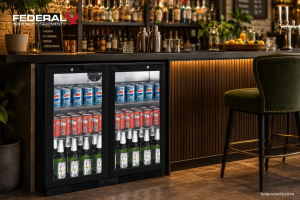
Underbench variants, supplied by the leading bar fridge dealers and distributors, are popular in New Zealand cafés and compact venues because they maximise workspace efficiency. Upright glass-door refrigeration units are better suited to venues prioritising beverage visibility and customer-facing displays. Before purchasing a unit, operators should carefully measure installation areas, doorway widths, ventilation gaps, and staff movement space.
Pre-Purchase Checklist
| Measurement Requirement | Why It Matters |
|---|---|
| Cabinet width and depth | Ensures correct fit |
| Door opening clearance | Allows easy staff access |
| Ventilation spacing | Prevents overheating |
| Power outlet location | Simplifies installation |
| Future storage growth | Avoids early replacement |
Proper sizing supports a smoother workflow and prevents costly installation adjustments later.
Why Is Ventilation So Important for Commercial Refrigeration?
Ventilation is one of the most overlooked aspects of commercial fridge installation. Refrigeration systems continuously generate heat and require adequate airflow around the compressors to operate efficiently.
Poor airflow forces compressors to work harder, increasing electricity consumption and shortening equipment lifespan. Most bar fridges in New Zealand are recommended to have ventilation clearances of 50-100mm around the unit. This becomes especially important in warmer New Zealand regions and humid hospitality environments where refrigeration systems, such as prep fridges, already work harder to maintain temperature.
| Installation Oversight | Potential Result |
|---|---|
| Blocked airflow | Compressor overheating |
| Tight cabinetry | Reduced efficiency |
| Insufficient rear clearance | Higher electricity usage |
| Poor ventilation | Shorter equipment lifespan |
| Nearby heat sources | Temperature instability |
Correct ventilation improves cooling performance, lowers maintenance requirements, and extends equipment life.
How Important Is Temperature Control for Beverage Quality?
Consistent cooling in your commercial bar fridge is essential for beverage presentation, customer satisfaction, and compliance with food safety regulations.
Different beverages require different storage temperatures for optimal taste and freshness. Fan-forced cooling systems circulate cold air evenly throughout the cabinet, preventing warm spots that commonly occur in static cooling systems. Digital controllers allow operators to monitor and maintain precise temperatures more accurately than manual dial systems.
| Beverage Type | Recommended Temperature |
|---|---|
| Beer | 1°C to 4°C |
| White wine | 7°C to 10°C |
| Soft drinks | 2°C to 5°C |
| Sparkling beverages | 3°C to 5°C |
Accurate temperature management improves beverage quality while reducing unnecessary compressor cycling.
Conclusion
Choosing the right bar fridge for a New Zealand hospitality business involves far more than selecting the lowest-priced unit. Commercial refrigeration directly influences beverage quality, workflow efficiency, energy consumption, and long-term operating costs.
Businesses that prioritise commercial-grade construction, efficient cooling systems, correct sizing, proper ventilation, and reliable temperature management create a more efficient cooling workflow and reduce unnecessary operational expenses.
FAQs: Buying a Bar Fridge in New Zealand
1. Why should I choose a commercial bar fridge instead of a domestic fridge?
A commercial bar fridge is designed for frequent door openings, faster temperature recovery, stronger cooling performance, and continuous hospitality use, making it more suitable for New Zealand venues.
2. What size bar fridge should my business buy?
The right size depends on your beverage range, trading volume, available space, ventilation clearance, staff access, and future storage needs.
3. How much ventilation does a bar fridge need?
Most commercial bar fridges need around 50-100mm of ventilation clearance, depending on the model and installation environment.
4. Are energy-efficient bar fridges worth it?
Yes. Since bar fridges operate continuously, energy-efficient features such as LED lighting, improved insulation, and inverter compressors can help reduce running costs.
5. What temperature should drinks be stored at?
Beer is commonly stored at 1°C to 4°C, soft drinks at 2°C to 5°C, sparkling beverages at 3°C to 5°C, and white wine at 7°C to 10°C.
6. What is the biggest mistake when buying a bar fridge?
One of the biggest mistakes is choosing a fridge based only on purchase price instead of considering energy use, commercial build quality, capacity, ventilation, and long-term reliability.
-
 Thermaster Under Bench single door Bar Cooler - LG-138HCSpecial Price NZ$659.40 (Excl. GST) Regular Price NZ$1,099.00 (Excl. GST)
 -
 Thermaster Under Bench Three Door Bar Cooler - LG-330HCSpecial Price NZ$1,199.40 (Excl. GST) Regular Price NZ$1,999.00 (Excl. GST)
 -
 Thermaster Under Bench Three Sliding Door Bar Cooler - LG-330SCSpecial Price NZ$1,199.40 (Excl. GST) Regular Price NZ$1,999.00 (Excl. GST)
 -

-