Customer Helpline:


Top Benefits of Using a Commercial Salad Prep Fridge for Food Businesses in New Zealand
Fresh food service in New Zealand has become faster, more competitive, and more operationally demanding. Cafés, sandwich bars, pizza shops, sushi stores, takeaway outlets, catering businesses, food trucks, and restaurants all need to prepare orders quickly while maintaining food safety, ingredient quality, and consistent presentation. In busy locations such as Auckland’s central business district, Wellington’s hospitality precincts, Christchurch’s café scene, and tourism-driven areas like Queenstown, kitchen efficiency can directly influence profitability.
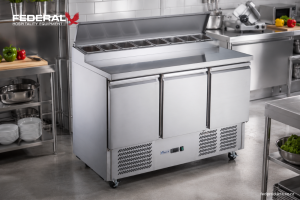
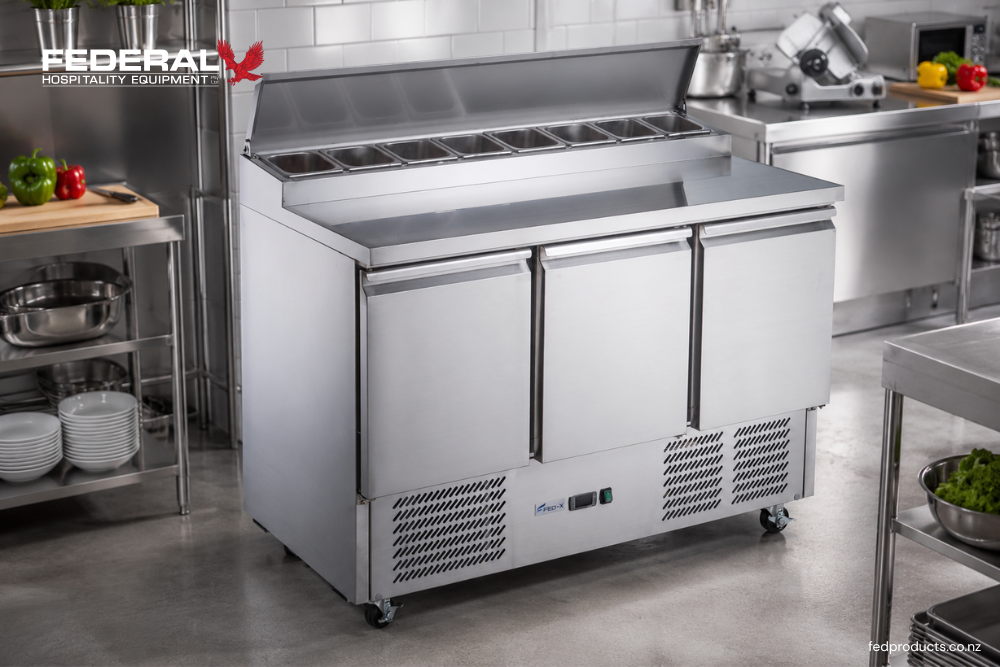
A commercial salad prep fridge is designed to solve one of the most common problems in fresh food preparation: staff need immediate access to chilled ingredients without constantly walking between a preparation bench and a separate refrigerator. Also known as a sandwich prep refrigerator, saladette, preparation fridge, refrigerated make-table, or refrigerated prep bench, this unit combines chilled storage, ingredient organisation, and preparation space into one workstation.
For Federal Hospitality Equipment New Zealand customers, a commercial salad prep fridge is not just a refrigeration product. It is a workflow solution. It helps keep perishable ingredients chilled, reduces unnecessary movement, improves preparation speed, supports stock rotation, saves space, and helps staff prepare made-to-order items with greater consistency.
What Is a Commercial Salad Prep Fridge?
A commercial salad prep fridge is a refrigerated workstation designed for businesses that prepare fresh, chilled, made-to-order food. It normally includes a stainless-steel worktop, refrigerated cabinet storage, and a chilled ingredient rail fitted with gastronorm pans. Staff can prepare food directly on the work surface while accessing chilled ingredients from the top rail or storage section below.
Gastronorm pans, often called GN pans, are standardised commercial kitchen containers used across professional foodservice operations. They help businesses organise ingredients, maintain portion consistency, simplify stock control, and speed up preparation. For example, a sandwich shop may use GN pans for lettuce, tomato, cheese, sliced meats, sauces, spreads, and pickles, while a pizza shop may use them for toppings, sauces, vegetables, and cheese.
These units, including the titular product and pizza prep benches and fridges, are designed for high-volume foodservice environments and help businesses support the requirements of the New Zealand Food Act 2014 and Ministry for Primary Industries food safety standards.
Why Are Commercial Salad Prep Fridges So Valuable for New Zealand Food Businesses?
The real value of a commercial salad prep fridge is that it combines several important kitchen functions into one practical unit. Instead of separating ingredient storage, preparation space, and assembly workflow, the prep fridge brings them together in the same station.
This matters because many New Zealand food businesses operate in compact kitchens where every square metre needs to work hard. In a busy café or takeaway kitchen, staff may prepare hundreds of orders across breakfast, lunch, and dinner service. If the layout forces them to keep walking to a separate fridge, delays build up quickly.
| Business Need | How a Salad Prep Fridge Helps? | Commercial Benefit |
|---|---|---|
| Fast order preparation | Ingredients are stored directly in the preparation zone. | Shorter order assembly time during busy periods. |
| Food safety | Perishable ingredients remain chilled during service. | Supports safer handling of dairy, seafood, meats, sauces, and salads. |
| Ingredient organisation | GN pans separate ingredients clearly. | Improves portion control and reduces errors. |
| Space efficiency | Combines refrigeration and preparation in one unit. | Reduces the need for separate benches and fridges. |
| Waste reduction | Ingredients are visible and easier to rotate. | Supports FIFO and reduces spoilage. |
How Does a Salad Prep Fridge Support Food Safety Compliance in New Zealand?
Food safety is one of the strongest reasons to invest in proper commercial refrigeration. Perishable foods can spoil or support bacterial growth when they are not stored under suitable temperature conditions. These include dairy products, seafood, meats, cooked proteins, ready-to-eat salads, sauces, dressings, and many prepared fillings.
A refrigerated salad bench helps keep ingredients chilled during preparation and service. This is especially important in businesses where ingredients are repeatedly accessed throughout the day. Unlike domestic refrigerators, commercial prep fridges are designed for frequent opening, heavy use, and busy service conditions.
New Zealand food businesses are expected to manage food safety risks under applicable food safety requirements, including processes aligned with the New Zealand Food Act 2014 and Ministry for Primary Industries guidance. A salad prep fridge does not replace good food safety procedures, but it supports better control by keeping chilled ingredients within a managed refrigeration environment.
How Does a Prep Fridge Improve Kitchen Workflow?
Kitchen workflow is about how efficiently food moves from storage to preparation, assembly, service, and cleaning. Poor workflow forces staff to take unnecessary steps, repeat movements, search for ingredients, and slow down during peak periods.
A commercial salad prep fridge improves workflow by creating a single preparation station where chilled ingredients, storage, and assembly space are all connected. This helps staff prepare orders with fewer interruptions.
| Traditional Preparation Setup | Prep Fridge Workflow | Operational Benefit |
|---|---|---|
| Staff repeatedly access separate cold storage. | Ingredients remain directly at the preparation station. | Reduces unnecessary movement. |
| Ingredients are exposed during repeated handling. | Ingredients stay chilled in GN pans. | Supports freshness and temperature control. |
| Multiple storage locations create delays. | Ingredients are organised in one location. | Improves preparation efficiency. |
| Separate prep benches and storage take up more space. | One unit combines both functions. | Optimises kitchen layout. |
For busy food businesses, this improved organisation can reduce preparation delays and support faster order turnaround without requiring a larger kitchen footprint.
How Does a Salad Prep Fridge Boost Workplace Speed?
Speed is critical in made-to-order food service. Customers expect fresh food, but they also expect quick service. A sandwich bar, pizza shop, sushi outlet, burger store, or café can lose efficiency if staff need to keep moving away from the preparation area to retrieve chilled ingredients.
A chilled preparation station improves workplace speed by keeping ingredients inside the primary work zone. Staff can assemble orders in sequence, refill GN pans when required, and maintain better rhythm during rush periods.
How Does a Prep Fridge Reduce Food Waste?
Food waste directly affects profitability. In fresh food businesses, waste often comes from poor ingredient visibility, over-preparation, inconsistent portioning, forgotten stock, and incorrect storage temperatures.
A salad prep fridge for sale allows staff to clearly view available ingredients, monitor stock levels, and follow FIFO practices. FIFO means First In, First Out. This helps ensure older ingredients are used before newer stock, reducing spoilage and unnecessary disposal.
GN pans also support portion control. Because ingredients are held in standardised containers, staff can prepare more consistent servings and avoid excessive use of high-cost ingredients such as cheese, seafood, premium meats, avocado, sauces, and specialty toppings.
| Waste Problem | How a Prep Fridge Helps? | Business Impact |
|---|---|---|
| Forgotten ingredients | Keeps stock visible in the prep station. | Reduces spoilage. |
| Over-portioning | GN pans support consistent serving habits. | Improves food cost control. |
| Poor rotation | Makes FIFO easier to manage. | Reduces expired or discarded stock. |
| Temperature exposure | Keeps chilled ingredients in a controlled environment. | Supports better ingredient quality. |
| Over-preparation | Allows smaller, organised refills during service. | Reduces end-of-day waste. |
How Does a Prep Fridge Save Space in Commercial Kitchens?
Commercial kitchen space is expensive in many parts of New Zealand. In compact urban hospitality sites, it is not always practical to install separate refrigerated storage, preparation benches, topping stations, and assembly counters. A salad prep fridge reduces this pressure by combining storage and preparation functions in one unit.
| Kitchen Type | How a Prep Fridge Helps? |
|---|---|
| Small café kitchen | Creates a compact preparation and storage station. |
| Restaurant kitchen | Improves station organisation during busy service. |
| Catering operation | Supports large-volume preparation with consistent ingredient access. |
| Food truck | Combines refrigeration and prep space where room is limited. |
| Pizza shop | Keeps toppings chilled and organised beside the assembly area. |
| Sushi outlet | Provides structured chilled storage for fillings and toppings. |
How Does Ergonomic Design Improve Staff Efficiency?
Kitchen productivity depends on more than equipment capacity. Staff comfort, reach distance, bench height, and movement patterns all affect performance during long shifts. If staff are constantly bending, twisting, or walking between stations, fatigue increases and service speed drops.
Commercial appliances sourced from the top salad prep fridge suppliers and manufacturers are designed at practical working heights, reducing unnecessary bending, reaching, and movement. A well-planned preparation station helps create a safer and more comfortable working environment for kitchen teams.
Ergonomic benefits are especially important in high-repeat operations such as sandwich shops, salad bars, pizza kitchens, and takeaway outlets where staff may assemble similar items hundreds of times per day.
Which Food Businesses Benefit Most From a Prep Fridge?
A refrigerated make-to-order table or sandwich prep counter table is suitable for many foodservice applications. Any business that prepares chilled ingredients into fresh menu items can benefit from the combination of organised storage and preparation space.
| Business Type | Common Use | Main Advantage |
|---|---|---|
| Cafés | Sandwiches, wraps, salads, breakfast items, cabinet food. | Faster fresh food preparation. |
| Pizza restaurants | Sauces, cheeses, vegetables, meats, and toppings. | Better topping organisation during peak periods. |
| Sushi businesses | Seafood, vegetables, sauces, fillings, and garnishes. | Chilled ingredient access in a compact station. |
| Catering companies | Bulk salad, wrap, platter, and sandwich preparation. | Consistent access for high-volume preparation. |
| Food trucks | Compact refrigerated preparation for mobile service. | Space-saving workflow. |
| Takeaway venues | Burger toppings, salads, sauces, and chilled fillings. | Fast assembly and better order consistency. |
| Institutional kitchens | School, university, healthcare, or workplace food preparation. | Structured preparation with better ingredient control. |
How Would a High-Volume Pizza Shop Use a Prep Fridge?
A high-volume pizza shop in Auckland can store sauces, vegetables, cheeses, meats, and toppings directly inside the preparation unit. During a busy evening service, staff can move quickly through the assembly process without repeatedly accessing separate refrigeration.
This improves throughput during peak periods because the team spends more time assembling orders and less time moving around the kitchen. It also helps maintain topping consistency, improves stock visibility, and supports faster refilling between rush periods.
How Does a Prep Fridge Improve Portion Control?
Portion control is an important part of profitability. If staff use too much of a high-cost ingredient on every order, food costs increase quickly. If portions are too small or inconsistent, customers may notice quality variation.
GN pans help staff work from clearly defined ingredient sections. When paired with portioning tools, recipe cards, and training, a prep fridge can support more consistent menu output.
| Ingredient Type | Why Portion Control Matters? | Prep Fridge Benefit |
|---|---|---|
| Cheese | Often high-cost and frequently overused. | Easy access with controlled refills. |
| Meats and seafood | High-value ingredients affect margins. | Better visibility and portion discipline. |
| Vegetables | Freshness and presentation matter. | Organised separation prevents messy handling. |
| Sauces and dressings | Overuse affects flavour and cost. | Clear layout supports recipe consistency. |
| Specialty toppings | Premium ingredients require careful control. | Smaller GN pans can limit over-preparation. |
How Energy Efficient Are Modern Prep Fridges?
Energy efficiency is an important consideration for New Zealand food businesses because commercial refrigeration usually runs continuously. When you buy commercial salad prep fridges online, many modern units are designed to reduce power consumption and may meet applicable Greenhouse and Energy Minimum Standards requirements.
Selecting an efficient model can help lower operating costs while supporting more sustainable kitchen operations. However, energy efficiency should not be considered in isolation. Businesses should also review capacity, temperature recovery, insulation, compressor quality, door seals, and maintenance access.
| Energy Feature | Why It Matters? | Business Benefit |
|---|---|---|
| Efficient compressor | Reduces power demand during continuous operation. | Lower running costs over time. |
| Quality insulation | Helps retain cold air. | Improved temperature stability. |
| Self-closing doors or drawers | Limits temperature loss during busy service. | Better efficiency and food safety support. |
| Accurate temperature control | Reduces unnecessary cooling cycles. | More stable ingredient storage. |
| Regular servicing | Keeps refrigeration components working correctly. | Longer equipment lifespan. |
What Should You Consider Before Buying a Prep Fridge?
Choosing the right prep fridge requires more than selecting a model based on width or price. Businesses should evaluate menu requirements, kitchen layout, GN pan capacity, storage volume, temperature control, cleaning access, supplier support, and future growth.
| Question | What to Check? |
|---|---|
| What size does my kitchen actually need? | Match unit dimensions and capacity with available space and menu volume. |
| How many GN pans are required? | Select enough ingredient capacity for daily preparation needs. |
| Does the unit maintain safe temperatures? | Confirm reliable temperature performance below the required food storage limits. |
| Is energy efficiency important? | Review energy performance and long-term operating costs. |
| Does the supplier provide support? | Choose equipment, supplied by the leading salad prep fridge dealers and distributors, with a strong warranty and local service availability. |
How Does a Prep Fridge Compare With a Standard Workbench and Reach-In Fridge?
| Feature | Prep Fridge | Separate Bench + Reach-In Fridge |
|---|---|---|
| Ingredient access | Immediate access during preparation. | Requires movement between stations. |
| Space usage | Combines functions in one unit. | Requires a separate equipment footprint. |
| Workflow | Designed for fast assembly. | More movement required. |
| Organisation | GN pans create structured storage. | Ingredients may be spread across locations. |
| Temperature management | Ingredients remain within the chilled preparation station. | More handling between storage and prep areas. |
| Cleaning routine | One station can be cleaned and reset. | Multiple areas require cleaning and coordination. |
What Are the Most Common Buying Mistakes?
| Mistake | Why It Creates Problems? | Better Approach |
|---|---|---|
| Choosing a unit that is too small | Staff run out of ingredient space during peak periods. | Match GN pan capacity to menu volume. |
| Ignoring kitchen measurements | The fridge may not fit or may block workflow. | Measure width, depth, clearance, and service access before purchase. |
| Overlooking cleaning access | Daily hygiene routines become harder. | Choose easy-clean surfaces and removable GN pans. |
| Ignoring energy use | Running costs may be higher over time. | Compare energy performance and insulation quality. |
| Not planning ingredient layout | Staff may still move inefficiently during service. | Place high-use ingredients closest to the main assembly position. |
| Choosing without service support | Repairs and parts may become difficult later. | Choose a supplier with commercial refrigeration knowledge and support. |
What Daily Maintenance Helps Protect Equipment Performance?
Good cleaning and maintenance protect food quality, hygiene, and equipment lifespan. Salad prep fridges operate in busy environments where food debris, moisture, frequent opening, and heavy use can affect performance if not managed properly.
| Maintenance Task | Recommended Action | Why It Matters? |
|---|---|---|
| Preparation surface cleaning | Clean after every service period. | Reduces residue and supports hygiene. |
| GN pan washing | Wash and sanitise regularly. | Prevents build-up and cross-contamination. |
| Door seal inspection | Check seals for damage or wear. | Helps maintain temperature efficiency. |
| Food debris removal | Remove debris from refrigerated areas. | Protects hygiene and airflow. |
| Temperature monitoring | Check readings daily. | Supports food safety management. |
| Professional servicing | Schedule according to manufacturer recommendations. | Protects long-term performance. |
What Should Be on a Commercial Salad Prep Fridge Buyer Checklist?
- Confirm your full menu and chilled ingredient list.
- Estimate daily and peak preparation volume.
- Measure available kitchen space carefully.
- Check delivery access before ordering.
- Choose the correct GN pan capacity.
- Review refrigerated storage volume underneath.
- Check temperature control and recovery performance.
- Review energy efficiency and running costs.
- Confirm cleaning access and removable components.
- Check door seals, worktop space, and storage cabinet design.
- Plan ingredient layout before installation.
- Train staff on FIFO, cleaning, refilling, and temperature checks.
- Confirm warranty and supplier support.
- Review whether the unit supports future menu growth.
Why Choose Federal Hospitality Equipment New Zealand?
Federal Hospitality Equipment New Zealand supplies commercial refrigeration and hospitality equipment for cafés, restaurants, pizza shops, sushi businesses, food trucks, catering operators, hotels, and foodservice businesses across New Zealand.
Choosing a salad prep fridge requires careful consideration of food safety, workflow, kitchen space, energy use, GN pan capacity, stock rotation, cleaning routines, warranty, and service support. Federal Hospitality Equipment New Zealand helps businesses compare practical refrigeration solutions that support faster preparation, better organisation, and long-term operational efficiency.
For businesses focused on fresh food preparation, reliable chilled storage, and streamlined service, a well-selected commercial salad prep fridge can become one of the most valuable workstations in the kitchen.
Conclusion
A commercial salad preparation fridge is an important piece of equipment for New Zealand food businesses focused on food safety, streamlined throughput, and efficient kitchen operations.
By combining chilled storage, preparation space, and ingredient organisation, these commercial refrigeration units help businesses improve service flow, reduce waste, optimise workspace, and maintain consistent food quality.
For cafés, restaurants, pizza shops, sushi venues, food trucks, and catering operations, a well-selected preparation fridge supports long-term operational efficiency, customer satisfaction, and profitability.
Frequently Asked Questions
What is a commercial salad prep fridge?
A commercial salad prep fridge is a refrigerated workstation that combines chilled ingredient storage, GN pan organisation, and food preparation space in one unit.
Why do New Zealand food businesses use salad prep fridges?
They use them to improve preparation speed, ingredient organisation, food safety, stock rotation, and kitchen workflow.
What foods can be stored in a salad prep fridge?
Common items include lettuce, tomato, cheese, cooked meats, seafood, sauces, dressings, spreads, pizza toppings, sushi fillings, and prepared salad ingredients.
How does a prep fridge help with food safety?
It helps keep perishable ingredients chilled during preparation and service, reducing the time ingredients spend outside refrigeration.
What are GN pans?
GN pans are standardised commercial kitchen containers used for ingredient organisation, portion control, and efficient stock management.
Can a prep fridge reduce food waste?
Yes. Better visibility, FIFO stock rotation, and portion control can reduce spoilage and unnecessary ingredient use.
Is a salad prep fridge useful for pizza shops?
Yes. Pizza shops can use prep fridges to organise sauces, cheese, vegetables, meats, and toppings beside the assembly area.
Are salad prep fridges suitable for food trucks?
Yes. Their combined refrigeration and preparation design can be useful in compact food truck layouts where space is limited.
How does a prep fridge save space?
It combines refrigerated storage and preparation space, reducing the need for separate benches and reach-in fridges.
How often should a prep fridge be cleaned?
Preparation surfaces should be cleaned after every service period, and GN pans should be washed and sanitised regularly.
What should I check before buying a prep fridge?
Check size, GN pan capacity, temperature performance, energy efficiency, cleaning access, storage volume, and supplier support.
Does a prep fridge use much power?
Energy use depends on size, insulation, compressor efficiency, usage patterns, and maintenance condition.
How can staff use a prep fridge more efficiently?
Staff can arrange ingredients in preparation order, refill GN pans properly, follow FIFO, and keep the workstation clean during service.
Why buy from Federal Hospitality Equipment New Zealand?
Federal Hospitality Equipment New Zealand supplies practical commercial refrigeration solutions for New Zealand food businesses, including options suited to cafés, restaurants, takeaway venues, pizza shops, food trucks, and catering operations.
Is a prep fridge better than using a standard fridge and bench?
For made-to-order food businesses, a prep fridge is usually more efficient because it keeps chilled ingredients and preparation space together in one organised workstation.
-
 FED-X Three Door Salad Prep Fridge - XGNS1300DNZ$3,199.00 (Excl. GST)
 -

-

-
 FED-X Three Door Salad Prep Fridge - XGNS1300SNZ$3,332.00 (Excl. GST)