 Customer Helpline:


In a busy commercial kitchen, preparing food is only one part of the job. Once soups, sauces, cooked meats, pastries and prepared meals leave the cooking area, they still need to be cooled, stored and handled correctly.
For New Zealand restaurants, cafés, bakeries, hotels and catering businesses, managing this process efficiently can make a considerable difference to food quality, kitchen organisation and food safety.
A commercial blast chiller and shock freezer is designed to reduce food temperatures much faster than conventional refrigerated storage equipment under suitable operating conditions. These specialised appliances help kitchens prepare food in advance, manage larger batches and move products through controlled chilling or freezing processes.
However, choosing the right machine involves more than comparing prices or counting tray positions.
The volume of food your kitchen prepares, the type of products you handle, the required cooling performance and the space available for installation all influence which model will be practical.
Digital controls, food-temperature probes, insulation, stainless steel construction and access to after-sales support are equally important considerations.
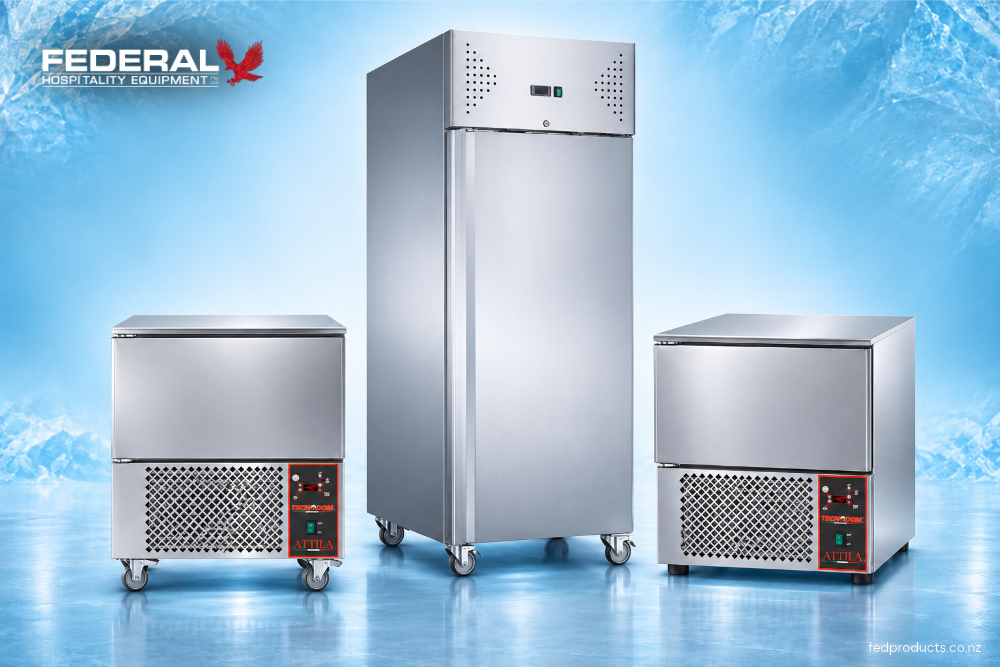
At Federal Hospitality Equipment New Zealand (FHE NZ), businesses can explore commercial blast chilling and shock freezing equipment from Thermaster and Tecnodom, including the Thermaster D-GT3 and Tecnodom DO3, DO5 and DO10 models.
This comprehensive buying guide explains the seven essential features to look for when purchasing a commercial blast chiller and shock freezer in New Zealand, helping hospitality operators make a more informed equipment decision.
When buying a commercial blast chiller and shock freezer, prioritise rated chilling and freezing capacity, reliable temperature reduction, suitable tray compatibility, programmable digital controls, food-temperature probes, energy efficiency, durable construction and after-sales support.
Choose a model according to the quantity and type of food processed per batch rather than cabinet volume alone. For example, FHE NZ offers the compact Thermaster D-GT3 and the Tecnodom DO3, DO5 and DO10 for different production requirements.
Always confirm the machine's current specifications, installation requirements and ability to support your documented food safety procedures under realistic loading conditions.
What Is a Commercial Blast Chiller?
A commercial blast chiller is specialised refrigeration equipment designed to reduce the temperature of food quickly after cooking or preparation.
Unlike an ordinary commercial refrigerator, which is primarily designed to hold food at a chilled temperature, a blast chiller is built to remove heat from food over a shorter period.
This can be particularly useful when a kitchen prepares cooked food in batches for later storage or service.
For example, a restaurant may prepare a large quantity of sauce in the morning, chill it using an approved process and transfer it to suitable refrigerated storage for later use.
The blast chiller supports the cooling stage of that workflow.
What Is a Commercial Shock Freezer?
A commercial shock freezer is designed to freeze suitable food products rapidly.
Rapid freezing can help protect the quality of some foods by limiting the formation of large ice crystals compared with slower freezing processes.
This can be useful for pastries, desserts, seafood and other products where texture and appearance are important.
However, freezing performance and final product quality depend on the food, its packaging, thickness and the machine's operating conditions.
Rapid freezing does not make unsafe food safe, and it does not replace appropriate handling and storage procedures.
Blast Chiller vs Shock Freezer: What Is the Difference?
| Feature | Blast Chiller | Shock Freezer |
|---|---|---|
| Main function | Rapidly reduces food temperature to a chilled condition | Rapidly freezes suitable food products |
| Typical applications | Cooked sauces, soups, meats and prepared meals | Pastries, desserts, seafood and products intended for frozen storage |
| Intended result | Food ready for appropriate chilled storage | Food ready for appropriate frozen storage |
| Buying priority | Chilling capacity and temperature-reduction performance | Freezing capacity and product quality |
| Combination equipment | Selected models provide both functions in one cabinet | |
A dual-function appliance may be useful where a kitchen regularly needs both rapid chilling and rapid freezing.
Why Do New Zealand Commercial Kitchens Use Blast Chillers and Shock Freezers?
Blast chilling and shock freezing can support several important aspects of foodservice operations.
Better Batch Preparation
Restaurants and caterers can prepare suitable dishes in advance and cool them using documented procedures.
More Organised Kitchen Workflows
Staff can plan preparation around quieter periods rather than completing every task immediately before service.
Food Quality Management
Controlled chilling and freezing can help preserve the texture, appearance and flavour of suitable products.
Food Safety Procedures
Rapid temperature reduction can help businesses manage the cooling of potentially hazardous food in accordance with applicable requirements.
Reduced Pressure During Service
Advance preparation may help kitchens manage busy lunch periods, dinner service and large events.
Potential Waste Reduction
Appropriate chilling, freezing and storage may help reduce avoidable spoilage, provided food is handled correctly and used within its validated shelf life.
These benefits depend on the kitchen's operating procedures and the equipment selected.
7 Essential Features to Consider When Buying a Commercial Blast Chiller and Shock Freezer
1. What Cooling Capacity Should a Commercial Blast Chiller Have?
Cooling capacity is one of the most important features to assess before purchasing.
The right machine depends on how much food your kitchen prepares in each batch, how frequently it needs to be chilled or frozen and the type of products being processed.
A small café may only need to cool relatively modest quantities of prepared food.
A hotel or catering business, on the other hand, may need to process multiple trays during a short preparation period.
Why Is Rated Capacity More Important Than Cabinet Volume?
Cabinet volume describes the amount of internal space available.
Rated chilling or freezing capacity indicates how much food the machine is designed to process under specified conditions.
These measurements are not interchangeable.
A cabinet with a large internal volume does not necessarily have the refrigeration performance required to chill an equally large mass of hot food within your required time.
When comparing machines, check both the tray configuration and the manufacturer's rated food-processing capacity.
How Much Capacity Does Your Kitchen Need?
| Kitchen Type | Recommended Capacity Consideration |
|---|---|
| Small cafés | Compact, low-volume units suited to smaller batches |
| Restaurants | Medium-capacity units with multiple tray positions |
| Bakeries | Tray compatibility and capacity suited to pastry and dough production |
| Hotels and caterers | Higher-capacity equipment for batch processing |
| Central kitchens | Larger systems suited to frequent production cycles |
These are planning considerations rather than fixed requirements.
How Do You Estimate Your Required Blast Chiller Capacity?
Start by identifying the largest quantity of food that needs to be chilled or frozen during one production cycle.
Consider:
- The total weight of food per batch.
- The number of trays required.
- The thickness and depth of food in each tray.
- The starting temperature of the food.
- The required final temperature.
- The time available for the process.
- How frequently batches need to be processed.
For example, a restaurant preparing 12kg of cooked food in one batch should not choose a machine based solely on the number of trays it can hold.
The kitchen must confirm that the machine can cool that quantity of the specific food safely within the required time.
Compact Thermaster Blast Chiller Option
The Thermaster D-GT3 is a three-tray blast chiller with a listed net cabinet volume of 33 litres.
It is designed to accommodate 2/3 gastronorm trays and may be worth considering for businesses with more modest production requirements.
However, buyers should confirm its rated chilling and freezing performance for the intended workload rather than relying on the 33-litre figure alone.
Tecnodom Blast Chiller Capacity Options
FHE NZ lists the Tecnodom DO3, DO5 and DO10 models.
These provide different tray configurations and rated processing capacities.
The DO3 and DO5 product listings specify the following:
| Model | Tray Capacity | Listed Chilling Capacity | Listed Freezing Capacity |
|---|---|---|---|
| Tecnodom DO3 | 3 × GN 1/1 or 600 × 400mm trays | 14kg from +70°C to +3°C | 8kg from +70°C to -18°C |
| Tecnodom DO5 | 5 × GN 1/1 or 600 × 400mm trays | 20kg from +70°C to +3°C | 15kg from +70°C to -18°C |
| Tecnodom DO10 | 10 × GN 1/1 or 600 × 400mm trays | Confirm current specification | Confirm current specification |
Manufacturer-rated capacities are achieved under specified test conditions and should not be treated as guaranteed results for every food product or loading arrangement.
Actual performance depends on food thickness, tray spacing, starting temperature and operating conditions.
2. Why Are Dual Chilling and Freezing Functions Important?
A combination blast chiller and shock freezer can perform two different temperature-reduction processes in one appliance.
This may be useful for kitchens preparing a mixture of chilled and frozen products.
When Is Blast Chilling Useful?
Blast chilling may be appropriate for:
- Cooked soups.
- Prepared sauces.
- Cooked meat dishes.
- Vegetable preparations.
- Rice and pasta dishes requiring controlled cooling.
- Prepared meals.
- Suitable bakery fillings.
Each product must be cooled using a procedure that meets the applicable food safety requirements.
When Is Shock Freezing Useful?
Shock freezing may be useful for:
- Pastries.
- Selected desserts.
- Prepared bakery products.
- Suitable seafood products.
- Portioned foods intended for frozen storage.
- Other manufacturer-approved products.
What Are the Benefits of a Dual-Function Machine?
A combination unit may reduce the need to purchase separate rapid-chilling and rapid-freezing appliances.
It can also offer flexibility when production requirements change.
However, the machine generally cannot be assumed to perform independent chilling and freezing cycles simultaneously within the same chamber.
Consider how your kitchen will schedule the different processes.
Tecnodom Combination Models
The Tecnodom DO3 and DO5 are listed by FHE NZ as blast chiller and shock freezer combination units.
The DO10 provides a larger configuration for businesses comparing greater tray capacity.
Before purchasing, confirm the dedicated chilling and freezing cycles available on the specific model.
3. What Temperature Range and Cooling Performance Should You Check?
Temperature performance is critical when choosing commercial blast chilling equipment.
A machine should be capable of reducing the temperature of suitable food consistently under the intended loading conditions.
The cabinet temperature alone does not establish whether the food itself has cooled sufficiently.
What Are the Food Cooling Requirements in New Zealand?
New Zealand food safety guidance for cooling cooked potentially hazardous food includes a two-stage process:
| Cooling Stage | Food Temperature | Maximum Time |
|---|---|---|
| First stage | 60°C down to 21°C | Within 2 hours |
| Second stage | 21°C down to 5°C or below | Within a further 4 hours |
This is the commonly specified two-stage cooling approach. Businesses must follow the requirements of their applicable food control plan or other approved food safety system, including any more specific conditions.
For authoritative guidance, refer to the New Zealand Ministry for Primary Industries (MPI).
Why Does Rapid Cooling Matter?
Potentially hazardous foods can support the growth of harmful microorganisms when they remain at unsuitable temperatures for too long.
Rapid cooling helps reduce the time food spends in conditions that may allow microbial growth.
However, purchasing a blast chiller does not automatically establish food safety compliance.
Staff must use appropriate food-handling procedures and verify that food reaches the required temperatures within the specified times.
Why Should You Measure the Core Temperature?
The centre of a food product can remain warmer than the air inside the cabinet.
This is particularly important with dense foods, large portions and deep trays.
A food-temperature probe helps monitor the actual temperature of the product.
Core temperature monitoring can provide more meaningful information than relying only on a cabinet display.
What Factors Affect Cooling Performance?
- Starting food temperature.
- Total food weight.
- Food thickness and density.
- Tray depth.
- Spacing between trays.
- Air circulation.
- Door-opening frequency.
- Ambient kitchen temperature.
- Condition of the refrigeration system.
How Can Kitchens Improve Cooling Performance?
Use appropriately sized trays, avoid overloading the machine and maintain the clearances specified by the manufacturer.
Where appropriate for the food and your validated process, dividing large quantities into smaller portions may support more effective cooling.
Staff should record food temperatures as required by the business's food safety procedures.
Does Shock Freezing Kill Bacteria?
No. Freezing does not reliably eliminate all harmful microorganisms.
Shock freezing should be understood as a rapid freezing and product preservation process, not a substitute for safe food handling, cooking or sanitation.
4. Are Programmable Digital Controls Necessary?
Programmable digital controls can make a commercial blast chiller easier to operate and help staff follow consistent procedures.
These features are particularly useful in kitchens that process different types of food throughout the day.
What Should You Look for in a Control Panel?
- Clearly displayed temperatures.
- Accessible cycle selection.
- Adjustable settings where appropriate.
- Reliable temperature sensors.
- Cycle-completion indicators.
- Clear operating instructions.
- Suitable probe monitoring.
What Is a Core Temperature Probe?
A core probe measures the temperature inside the food.
It can help staff monitor whether a product is cooling as expected.
Probe placement is important, especially for large or irregularly shaped portions.
Staff should follow the manufacturer's instructions for inserting, cleaning and using the probe.
Why Are Digital Controls Useful for Batch Preparation?
A restaurant may prepare cooked sauces, vegetables and meat dishes on the same day.
These foods can have different cooling characteristics.
Appropriate cycle controls and monitoring can help staff select and follow the correct process for each product.
Do Digital Controls Replace Manual Temperature Checks?
Not necessarily.
Depending on the machine and your food safety procedures, additional temperature verification or records may still be required.
Check how the appliance records temperatures and whether its features meet your operational requirements.
Tecnodom Digital Controls and Probes
FHE NZ lists the Tecnodom DO3 and DO5 with digital controllers, temperature displays, chamber probes and core probes.
These features may help businesses monitor chilling and freezing cycles.
Thermaster D-GT3 Controls
The Thermaster D-GT3 listing identifies a digital controller with a probe and temperature display.
For smaller kitchens, straightforward temperature monitoring may be an important buying consideration.
5. Why Should You Consider Energy Efficiency and Insulation?
Commercial refrigeration equipment can contribute significantly to a hospitality business's electricity costs.
Blast chillers and shock freezers use refrigeration systems to remove heat from food, and their energy consumption depends on operating conditions.
When comparing models, consider the appliance's efficiency alongside its cooling capacity.
What Affects Blast Chiller Electricity Consumption?
- Rated electrical power.
- Amount of food processed.
- Starting food temperature.
- Selected chilling or freezing cycle.
- Cabinet insulation.
- Door-opening frequency.
- Ambient kitchen temperature.
- Ventilation and maintenance.
Why Is Cabinet Insulation Important?
Effective insulation helps reduce heat transfer between the cabinet and the surrounding environment.
This supports stable operating conditions and can reduce unnecessary heat gain.
The Tecnodom DO3 and DO5 listings specify 40mm cabinet insulation.
However, insulation thickness alone does not provide a complete measure of energy efficiency.
Why Do Door Seals Matter?
Worn or damaged door seals can allow unwanted air exchange.
This may affect cooling performance and increase the work required from the refrigeration system.
Check door gaskets and hinges during routine maintenance.
What About Refrigerant Technology?
Different commercial refrigeration models may use different refrigerants and system designs.
Before purchasing, review the manufacturer's refrigerant information and any installation or servicing requirements.
Do not assume that all blast chillers use the same refrigerant.
Does a Larger Blast Chiller Always Use More Electricity?
Not necessarily in every operating scenario.
A larger machine may have a higher rated power, but energy used per batch depends on loading, operating time and refrigeration performance.
A properly sized machine may be more practical than a smaller unit that requires repeated cycles.
Compare expected energy consumption for your actual workload rather than power ratings alone.
How Can You Reduce Unnecessary Energy Use?
Good operating practices include:
- Avoiding unnecessary door openings.
- Following the recommended loading arrangement.
- Maintaining clean condenser and ventilation areas.
- Checking door seals.
- Using appropriate chilling or freezing cycles.
- Following scheduled servicing requirements.
Never reduce required cooling performance or compromise food safety simply to save electricity.
6. Does Stainless Steel Construction Matter?
Commercial blast chillers operate in demanding kitchen environments where durability and cleaning access are important.
Stainless steel is commonly used in commercial refrigeration because it offers corrosion resistance and a practical surface for routine cleaning.
However, construction quality involves more than the cabinet's exterior appearance.
What Are the Benefits of Stainless Steel Construction?
- Corrosion resistance.
- Durability during regular commercial use.
- Suitability for appropriate cleaning procedures.
- A professional appearance.
- Practical maintenance of food-contact and surrounding surfaces.
What Interior Features Make Cleaning Easier?
Look for:
- Smooth internal surfaces.
- Rounded internal corners.
- Accessible tray supports.
- Removable components where provided.
- Suitable drainage arrangements.
- Clear cleaning instructions.
Why Are Rounded Internal Corners Useful?
Rounded corners can make internal surfaces easier to wipe and reduce areas where residue may accumulate.
The Tecnodom DO3 and DO5 listings identify rounded internal corners and stainless steel construction.
What Should You Check About Doors and Hinges?
Commercial refrigeration doors are opened repeatedly throughout the day.
Check the quality and operation of:
- Door hinges.
- Magnetic gaskets.
- Handles.
- Self-closing mechanisms, where provided.
- Door alignment.
A properly closing door helps maintain the intended cabinet conditions.
Why Does Drainage Matter?
Condensation and defrosting can produce water that must be managed appropriately.
Check the machine's drainage design and maintenance requirements.
Some Tecnodom models list self-evaporating drainage and automatic defrost features.
How Often Should a Blast Chiller Be Cleaned?
Cleaning frequency depends on use, the products handled and the manufacturer's instructions.
Food-contact areas should be cleaned and sanitised according to the business's food safety procedures.
Refrigeration components may also require periodic inspection and servicing.
Always isolate the appliance and follow the manufacturer's instructions before carrying out cleaning or maintenance.
7. What Size and Tray Compatibility Should You Check?
A commercial blast chiller must fit into the available kitchen space without obstructing staff movement or disrupting preparation.
Its tray configuration should also suit the equipment and containers already used in the kitchen.
What Is a Gastronorm Tray?
Gastronorm trays are standardised food containers used in many commercial kitchens.
They are available in different sizes and depths.
Compatibility with standard tray formats can make it easier to transfer suitable food between preparation equipment, ovens and chilling appliances.
What Does GN 1/1 Mean?
GN 1/1 is a common gastronorm format with nominal plan dimensions of 530 × 325mm.
However, the overall tray depth and the machine's internal spacing must also be considered.
What Tray Formats Do Tecnodom Blast Chillers Support?
FHE NZ lists the Tecnodom DO3 and DO5 as compatible with GN 1/1 or 600 × 400mm bakery trays.
The product descriptions specify 40mm-deep trays for the stated configurations.
Confirm compatibility with your actual trays before ordering.
Why Does Tray Depth Matter?
Deep trays containing dense food can affect cooling performance.
Tray depth also influences how many trays can fit while maintaining the required airflow.
Follow the manufacturer's guidance on tray size, loading and spacing.
What Installation Measurements Should You Take?
Measure:
- Available width.
- Available depth.
- Available height.
- Door-opening clearance.
- Ventilation space.
- Access for cleaning.
- Access for servicing.
- Electrical outlet location.
- Delivery access into the kitchen.
Why Is Ventilation Clearance Important?
Commercial refrigeration systems need suitable airflow to remove heat.
Insufficient ventilation can affect performance.
Always follow the manufacturer's installation instructions and minimum clearances.
What About the PG210FA-B Bench Station?
FHE NZ also lists the PG210FA-B three-door bench station with capacity for six GN 1/1 pans.
This type of equipment may be relevant to kitchens looking for refrigerated preparation space and tray-compatible storage.
However, a refrigerated bench station is not a substitute for a blast chiller unless it has independently verified rapid-chilling capability.
Use a blast chiller for the rapid cooling process and suitable refrigerated storage equipment for subsequent holding, according to your food safety procedures.
Thermaster vs Tecnodom Blast Chillers: Which Brand Should You Consider?
Federal Hospitality Equipment NZ offers blast chilling equipment from Thermaster and Tecnodom.
These brands provide different models for businesses with varying production needs.
Thermaster Commercial Blast Chillers
The Thermaster D-GT3 is a compact three-tray model with a listed net capacity of 33 litres.
It is worth considering for smaller kitchens where space and batch size are important constraints.
Its product listing includes stainless steel construction, a digital controller, temperature probe and automatic defrost.
Tecnodom Blast Chillers and Shock Freezers
Tecnodom offers combination blast chilling and shock freezing models in different sizes.
The FHE NZ range includes the DO3, DO5 and DO10.
The DO3 and DO5 listings identify stainless steel construction, digital controls, core probes, self-closing doors and GN-compatible tray supports.
Brand Comparison
| Brand / Model | Configuration | Main Buying Consideration |
|---|---|---|
| Thermaster D-GT3 | Three trays; 33L net volume | Compact equipment for smaller batch requirements |
| Tecnodom DO3 | Three GN 1/1 tray positions | Combination chilling and freezing for smaller commercial batches |
| Tecnodom DO5 | Five GN 1/1 tray positions | Greater processing capacity and tray flexibility |
| Tecnodom DO10 | Ten GN 1/1 tray positions | Larger tray configuration for higher production requirements |
There is no single best brand or model for every commercial kitchen.
The correct choice depends on your food products, required cooling performance, space and budget.
Thermaster D-GT3 vs Tecnodom DO3 vs DO5 vs DO10
| Model | Tray Capacity | Cabinet / Processing Information | Potential Application |
|---|---|---|---|
| Thermaster D-GT3 | Three 2/3 GN trays | 33L net cabinet volume | Compact kitchens and smaller batches |
| Tecnodom DO3 | Three GN 1/1 or 600 × 400mm trays | 14kg chilling; 8kg freezing under listed test conditions | Restaurants and bakeries with smaller batch requirements |
| Tecnodom DO5 | Five GN 1/1 or 600 × 400mm trays | 20kg chilling; 15kg freezing under listed test conditions | Busy restaurants, hotels and catering kitchens |
| Tecnodom DO10 | Ten GN 1/1 or 600 × 400mm trays | Check current rated processing capacity | Larger production kitchens |
Tray count, cabinet volume and rated food-processing capacity measure different things. Compare all three where available.
Which Blast Chiller Is Best for a Small Café?
A small café may need to cool prepared sauces, fillings, cooked ingredients and selected desserts in relatively small batches.
For this type of operation, a compact machine may be worth considering.
The Thermaster D-GT3 provides a smaller cabinet configuration, while the Tecnodom DO3 offers three GN 1/1 tray positions and combined chilling and freezing functions.
Choose according to the food being processed and the required cooling performance.
Which Blast Chiller Is Suitable for a Restaurant?
Restaurants may prepare cooked proteins, sauces, vegetables and other dishes in advance.
A medium-capacity machine can be useful where several trays need to be processed during one cycle.
The Tecnodom DO3 and DO5 are worth comparing.
Consider how many kilograms of food must be cooled at once and whether the machine will also be used for shock freezing.
What Blast Chiller Should a Bakery Choose?
Bakeries and patisseries may use rapid chilling or freezing for suitable pastry components, desserts and prepared products.
Tray compatibility is particularly important.
If your bakery already uses 600 × 400mm trays, check whether the selected machine supports that format.
The Tecnodom DO3 and DO5 listings identify compatibility with 600 × 400mm bakery trays.
Confirm the permitted tray depth and product loading before purchasing.
What Blast Chiller Is Suitable for a Hotel Kitchen?
Hotels may prepare larger quantities of food for restaurants, breakfast service, conferences and functions.
Capacity, consistency and convenient batch handling are important considerations.
A five- or ten-tray model may be worth comparing where the kitchen has substantial production requirements.
However, the final decision should be based on validated cooling performance and the available installation space.
What Should Catering Businesses Look for in a Shock Freezer?
Catering businesses often prepare food ahead of events and may need to process several different products.
Consider whether a dual-function machine can support both chilling and freezing.
Also assess the number of cycles required to process the planned quantity of food.
Access to local servicing may be particularly important where equipment downtime could affect event preparation.
Can a Blast Chiller Replace a Commercial Refrigerator?
Not generally.
A blast chiller is primarily designed for rapid temperature reduction.
A commercial refrigerator is intended to maintain suitable chilled storage conditions.
After blast chilling, food should be transferred to appropriate storage according to the manufacturer's instructions and your food safety procedures.
Can a Shock Freezer Replace a Chest Freezer?
A shock freezer is designed to freeze food rapidly.
A chest freezer is generally intended for frozen storage.
These functions are different.
A business may need both rapid-freezing equipment and suitable frozen storage capacity.
How Do Blast Chillers Help with Food Preparation Planning?
Commercial kitchens can use blast chilling as part of a planned cook-chill workflow.
For example:
- Prepare and cook the food using the approved recipe and process.
- Portion or arrange the food in suitable containers.
- Load the blast chiller according to the manufacturer's instructions.
- Select the appropriate validated cooling cycle.
- Monitor the food's temperature.
- Confirm that the cooling requirements have been met.
- Transfer the food to suitable refrigerated storage.
- Label, store and use the product according to the business's food safety system.
Actual procedures may differ depending on the product and the requirements of the food control plan.
What Are the Common Mistakes When Buying a Blast Chiller?
Choosing by Cabinet Volume Alone
Internal volume does not establish rated chilling capacity.
Ignoring Food Weight and Thickness
Dense or deep food portions may take longer to cool.
Overlooking Tray Compatibility
Not all machines accept the same GN or bakery tray formats.
Buying a Machine That Is Too Small
An undersized unit may require too many cycles during busy production periods.
Buying a Machine That Is Too Large
Unnecessary capacity can increase purchase cost and take up valuable kitchen space.
Not Checking Electrical Requirements
Confirm voltage, plug type and power requirements before ordering.
Ignoring Ventilation
Insufficient clearance can interfere with refrigeration performance.
Not Using Core Temperature Measurements
Cabinet air temperature alone does not verify that food has cooled sufficiently.
Overlooking Cleaning and Maintenance
Door seals, internal surfaces and refrigeration components require appropriate maintenance.
Not Checking Warranty and Service Support
Repair arrangements and spare parts can affect long-term operating costs.
How Do You Choose the Right Commercial Blast Chiller and Shock Freezer?
The right machine should match your kitchen's production volume, food safety procedures, available space and budget.
Before purchasing, compare the following features:
| Buying Consideration | What to Look For |
|---|---|
| Capacity | Suitable tray and batch-processing capacity |
| Cooling performance | Reliable chilling and freezing cycles |
| Temperature control | Accurate digital controls and sensors |
| Energy efficiency | Effective insulation and suitable refrigeration performance |
| Construction | Durable, easy-to-clean stainless steel |
| Compatibility | Suitable GN or bakery tray dimensions |
| After-sales service | Warranty, servicing and spare parts |
Commercial Blast Chiller and Shock Freezer Buying Checklist
- The maximum weight of food processed per batch.
- Required chilling and freezing functions.
- Rated chilling capacity in kilograms.
- Rated freezing capacity in kilograms.
- Manufacturer-specified test conditions.
- Number of tray positions.
- GN or bakery tray compatibility.
- Permitted tray depth.
- Temperature range and cycle options.
- Availability of a core temperature probe.
- Digital control features.
- Food safety recording requirements.
- Electrical specifications.
- Available kitchen space.
- Ventilation clearances.
- Door-opening space.
- Stainless steel construction.
- Cleaning and drainage arrangements.
- Energy consumption information.
- Warranty duration and conditions.
- Local servicing and spare parts.
- Current price and availability.
- Delivery and installation requirements.
Why Choose Federal Hospitality Equipment New Zealand?
Federal Hospitality Equipment NZ supplies commercial refrigeration and kitchen equipment for New Zealand hospitality businesses.
Its blast chiller and shock freezer range includes equipment from Thermaster and Tecnodom.
Businesses can compare the compact Thermaster D-GT3 with the Tecnodom DO3, DO5 and DO10 combination models.
These options provide different cabinet sizes, tray configurations and processing capabilities.
FHE NZ also offers related commercial refrigeration equipment, including chest freezers and undercounter workbench freezers, which may support separate storage requirements.
Before ordering, confirm the current specifications, availability and support arrangements for your chosen model.
Whether you are upgrading a restaurant kitchen, fitting out a bakery or planning a catering operation, the right equipment starts with understanding your production requirements.
Explore Thermaster and Tecnodom blast chillers and shock freezers at Federal Hospitality Equipment New Zealand.
Compare capacity, temperature performance, digital controls, tray compatibility and after-sales support.
Browse Commercial Blast Chillers and Shock Freezers at FHE NZ
Conclusion
Investing in the right commercial blast chiller and shock freezer can support food safety management, improve kitchen organisation and help New Zealand hospitality businesses maintain consistent food quality.
From compact Thermaster units to larger Tecnodom combination models, the correct choice depends on your kitchen's daily output, batch sizes and operating requirements.
Before purchasing, prioritise rated cooling performance, tray capacity, programmable controls, energy efficiency, stainless steel construction and reliable after-sales support.
Also consider how the appliance will work alongside your existing commercial refrigerators and freezers.
With suitable equipment, trained staff and appropriate food safety procedures, restaurants, cafés, bakeries, hotels and catering businesses can streamline preparation, manage food storage more effectively and reduce avoidable waste.
Frequently Asked Questions About Commercial Blast Chillers and Shock Freezers
What is the best commercial blast chiller in New Zealand?
The best model depends on batch size, food type, cooling requirements, available space and budget. FHE NZ offers Thermaster and Tecnodom models for different commercial applications.
How do I choose a commercial blast chiller?
Compare rated chilling capacity, tray configuration, temperature controls, core probes, construction, energy consumption and warranty support.
What is the difference between a blast chiller and a shock freezer?
A blast chiller rapidly reduces food to a chilled temperature, while a shock freezer rapidly freezes suitable products.
Can one machine perform both blast chilling and shock freezing?
Yes. Combination models such as the Tecnodom DO3 and DO5 provide both functions.
What is the Thermaster D-GT3?
It is a compact three-tray blast chiller with a listed net cabinet capacity of 33 litres and compatibility with 2/3 GN trays.
What is the Tecnodom DO3?
It is a three-tray combination blast chiller and shock freezer with listed chilling capacity of 14kg and freezing capacity of 8kg under specified conditions.
What is the Tecnodom DO5?
It is a five-tray combination blast chiller and shock freezer with listed chilling capacity of 20kg and freezing capacity of 15kg under specified conditions.
What is the Tecnodom DO10?
It is a larger Tecnodom blast chiller and shock freezer with ten GN 1/1 tray positions. Confirm current processing specifications before purchasing.
Which is better, Thermaster or Tecnodom?
Neither brand is automatically better for every kitchen. Compare the individual models against your capacity, space and operating requirements.
How much food can a blast chiller cool?
The amount depends on the machine's rated chilling capacity and the conditions under which the food is processed.
Why is kilogram capacity important?
It helps buyers assess how much food the machine is designed to chill or freeze during a specified process.
Is cabinet volume the same as chilling capacity?
No. Cabinet volume measures internal space, while chilling capacity measures rated food-processing performance.
What are the food cooling requirements in New Zealand?
The commonly specified two-stage process is cooling cooked potentially hazardous food from 60°C to 21°C within two hours, then to 5°C or below within a further four hours. Follow your applicable food safety requirements.
Why is a core temperature probe important?
It helps measure the temperature inside the food rather than relying only on cabinet air temperature.
Do blast chillers need digital controls?
Digital controls can support consistent operation, but the required features depend on the kitchen's processes and monitoring needs.
Can blast chillers be used for cooked rice?
They can form part of an appropriate rapid-cooling process for cooked rice. Follow the applicable food safety procedures because rice can present risks when cooled incorrectly.
Can a blast chiller cool soup?
Yes, provided the machine is suitable for the quantity and container arrangement and the process meets the required cooling conditions.
Can a shock freezer be used for pastries?
Yes, suitable pastries and bakery products may be rapidly frozen using a compatible shock freezer.
Can blast chillers be used for seafood?
Selected blast chilling or freezing processes may be suitable for seafood. Product handling and temperature requirements must be followed.
Does shock freezing kill bacteria?
No. Freezing does not reliably eliminate harmful microorganisms and does not replace safe food handling.
What is GN 1/1 tray compatibility?
It means the appliance can accommodate a specified GN 1/1 tray configuration, subject to permitted tray depth and spacing.
Can Tecnodom blast chillers hold bakery trays?
The DO3 and DO5 listings identify compatibility with 600 × 400mm bakery trays under specified configurations.
Does a blast chiller replace a refrigerator?
Not generally. A blast chiller is designed for rapid cooling, while a refrigerator is intended for chilled storage.
Does a shock freezer replace a chest freezer?
Not necessarily. A shock freezer is designed for rapid freezing, while a chest freezer is generally intended for frozen storage.
Are stainless steel blast chillers easier to clean?
Stainless steel provides practical cleaning and corrosion-resistance benefits, but accessibility and construction design also matter.
How much electricity does a commercial blast chiller use?
Consumption depends on the model, cycle, food load, ambient temperature and operating conditions.
How much ventilation does a blast chiller need?
Follow the manufacturer's installation instructions and minimum clearances for the specific model.
How often should a commercial blast chiller be cleaned?
Follow the manufacturer's cleaning instructions and the business's food safety procedures. Maintenance frequency depends on usage and operating conditions.
What warranty is available on Thermaster and Tecnodom blast chillers?
FHE NZ currently lists a two-year parts and labour warranty for the Thermaster D-GT3 and Tecnodom DO3 and DO5, subject to applicable terms.
Where can I buy a commercial blast chiller in New Zealand?
Federal Hospitality Equipment NZ supplies Thermaster and Tecnodom blast chillers and shock freezers through its New Zealand website.


