Customer Helpline:




Commercial kitchen taps and faucets do far more than simply deliver water. In a busy restaurant, café, bakery, hotel, catering kitchen or other New Zealand foodservice operation, they may be used continuously for washing ingredients, rinsing cookware, cleaning benches, filling containers and supporting dishwashing throughout the day.
Because of this frequent use, a commercial tap needs to be selected differently from a typical domestic faucet. The right model should combine durability, practical water control, suitable reach, easy cleaning and compatibility with the sink and overall kitchen layout.
When choosing commercial kitchen taps and faucets in New Zealand, important factors include construction quality, mounting style, handle design, spout height and reach, swing range, pre-rinse functionality, hose length, water connections and ease of maintenance.
Federal Hospitality Equipment New Zealand offers commercial taps, faucets and pre-rinse units from Sunmixer, with different configurations designed for professional kitchen washing areas.
Choose a commercial kitchen tap according to your sink size, installation position and daily workload. Look for durable construction, an ergonomic handle, the correct mounting style, suitable spout height and reach, practical swing movement and easy-clean surfaces. For busy dishwashing areas, a pre-rinse unit with sufficient hose reach can also improve washing efficiency.
What Are the Most Important Features of a Commercial Kitchen Tap?
A commercial faucet should be built for repeated operation. In a busy hospitality kitchen, staff may turn a tap on and off many times during a single service period, so ease of use and construction quality are important.
| Feature | Why It Matters in a Commercial Kitchen |
|---|---|
| Heavy-Duty Construction | Helps the fixture cope with frequent everyday use. |
| Ergonomic Handle | Allows staff to control water quickly and comfortably. |
| Correct Mounting Style | Ensures the faucet is compatible with the sink, bench and plumbing layout. |
| High or Gooseneck Spout | Provides additional clearance for larger pots, containers and cookware. |
| Pre-Rinse Spray Unit | Helps remove food residue from plates and cookware before the main wash cycle. |
| Flexible Hose | Provides additional reach around a large washing area. |
| Swing Nozzle | Allows water to be directed across different parts of the sink. |
| Easy-Clean Design | Supports routine hygiene and maintenance. |
| Correct Water Connections | Supports proper installation and suitable performance. |
Why Is Durability Important in a Commercial Faucet?
Durability should be one of the first considerations because commercial kitchen fixtures operate in a demanding environment.
Taps can be exposed to water, food residue, cleaning products, heat and constant handling throughout the working day. A professional faucet should therefore be designed to withstand repeated use without becoming impractical for staff.
Stainless steel is commonly used across professional kitchen equipment because it provides a durable, corrosion-resistant and easy-to-clean surface. When comparing faucets, also consider the quality of the handles, spout, hose connections and other moving parts.
In a high-volume restaurant or catering kitchen, replacing a heavily used faucet can disrupt workflow, so choosing a robust commercial model from the start can be worthwhile.
Why Does Handle Design Matter?
Handle design directly affects how easily staff can turn the water on and off during busy preparation and cleaning tasks.
A conventional handle may work well for general washing, while front, top or wrist-action handles may suit different installation positions and workflows.
For example, a wrist-action handle can be useful where staff frequently need to operate the faucet while their hands are wet or occupied.
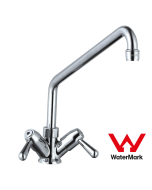
The Sunmixer Deck Mounted Faucet with Wrist-Action Handle T20111 is one example of a commercial configuration designed around this type of operation.
Front Handle vs Top Handle vs Side Handles: Which Is Better?
There is no universally better handle type. The correct configuration depends on the position of the sink and how staff approach it.
| Handle Type | When It Can Be Useful |
|---|---|
| Front Handle | Can be convenient when a tap is installed close to a wall or splashback. |
| Top Handle | Can provide straightforward access from different positions around the sink. |
| Wrist-Action Handle | Useful where staff often operate the tap with wet or occupied hands. |
| Two Side Handles | Can suit kitchens that prefer separate hot and cold-water controls. |
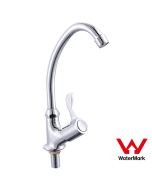
Federal Hospitality Equipment New Zealand currently carries Sunmixer configurations including the T20140L front-handle faucet, T20154 top-handle faucet, T20111 wrist-action faucet and T20138 two-side-handle faucet.
What Is the Difference Between Deck-Mounted and Wall-Mounted Faucets?
Mounting style is one of the most important practical decisions because it determines how the faucet integrates with the sink or bench.
Deck-Mounted Faucets
A deck-mounted faucet is installed directly into the sink or workbench area.
This can be a practical option where suitable mounting holes and connections are already available and the sink design accommodates the fixture.
Wall-Mounted Faucets
A wall-mounted faucet is fixed above the sink rather than through the sink deck.
This can help keep the sink or bench area clearer and may suit kitchens where bench space is limited.
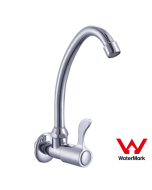
The Sunmixer Wall Mounted Gooseneck Faucet with Front Handle T20139L is an example of this configuration.
Choose deck-mounted when the sink or bench has suitable mounting points and the installation suits the workspace. Consider a wall-mounted faucet when you want to keep the sink deck clear or when the existing plumbing and layout are better suited to a wall installation.
What Should You Measure Before Buying a Commercial Tap?
Before purchasing, check the entire washing station rather than looking only at the faucet dimensions.
Measure and confirm:
- sink width and depth;
- available mounting holes;
- distance from the mounting point to the sink bowl;
- clearance above the sink;
- wall or splashback position;
- water connection requirements;
- nearby equipment;
- spout reach;
- spout height; and
- required hose reach for pre-rinse equipment.
A faucet that technically fits the mounting point may still be impractical if the spout is too short, too long or poorly positioned for the actual sink.
Why Is Spout Height Important?
Spout height affects how much clearance is available beneath the faucet.
A higher or gooseneck spout can be useful where staff regularly wash or fill large pots, stockpots, containers and cookware.
However, additional height should still be matched to the sink. A very high spout over a shallow sink can contribute to splashing, so the objective is sufficient working clearance rather than simply choosing the tallest faucet available.
Why Does Spout Reach Matter?
Spout reach determines where the water lands within the sink.
A spout that is too short may direct water too close to the back edge and fail to cover the full working area. A spout that is too long can direct water too close to the front of the sink or increase splashing.
The right length should place the water where staff actually need it while allowing practical access around the sink.
What Is a Swing Nozzle?
A swing nozzle allows the spout to move from side to side rather than remaining fixed in one position.
This can be useful in larger commercial sinks, particularly when staff need to move water between multiple washing areas or different sections of a large sink bowl.
Federal Hospitality Equipment NZ offers Sunmixer configurations with different swing-nozzle lengths, including 152 mm and 305 mm options. :contentReference[oaicite:2]{index=2}
How Do You Choose the Right Swing-Nozzle Length?
Choose the nozzle length according to the sink dimensions.
A smaller sink may only need a relatively short swing nozzle, while a wider washing area can benefit from extra reach.
The goal is to provide enough coverage without creating unnecessary overhang or splashing.
When Should You Choose a Pre-Rinse Unit?
A commercial pre-rinse unit can be particularly useful in busy dishwashing areas where staff regularly handle plates, pans and cookware with food residue.
The spray hose gives staff greater reach than a fixed faucet and allows food particles and residue to be rinsed away before items enter the main dishwashing process.
This can support a more efficient washing workflow in restaurants, cafés, catering kitchens, bakeries, hotels and institutional foodservice operations.
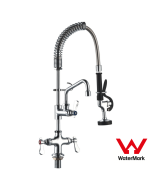
A pre-rinse unit uses a flexible spray hose to rinse food residue from plates, pans and cookware before washing. It is especially useful in high-volume dishwashing areas where reach, speed and flexibility are important.
Which Sunmixer Pre-Rinse Units Are Available?
Federal Hospitality Equipment New Zealand's current Sunmixer range includes several commercial pre-rinse configurations.
Examples include:
- Sunmixer T98001MN-1 Mini Pre Rinse Unit with 180 mm riser and 560 mm hose;
- Sunmixer T98001-1 Pre Rinse Unit with 510 mm riser and 1118 mm hose;
- Sunmixer T98001MN-2 Pre Rinse Unit with add-on faucet and 152 mm swing nozzle;
- Sunmixer T98001MN-2C Pre Rinse Unit with add-on faucet and 152 mm swing nozzle; and
- Sunmixer T98001-2 Pre Rinse Unit with add-on faucet and 305 mm swing nozzle.
The available options show why sink size, overhead clearance and required hose reach should all be considered before choosing a pre-rinse system.
Mini Pre-Rinse vs Full-Size Pre-Rinse: Which Do You Need?
A compact pre-rinse unit can suit smaller sinks or kitchens with limited overhead space, while a taller unit with a longer hose can provide greater reach in a larger dishwashing area.
| Kitchen Requirement | Suitable Approach |
|---|---|
| Compact Sink Area | Mini pre-rinse configuration |
| Large Washing Area | Longer riser and hose |
| Need Fixed Faucet + Spray | Pre-rinse unit with add-on faucet |
| Wide Sink | Longer swing-nozzle option |
| Limited Overhead Clearance | Lower-profile pre-rinse unit |
Why Does Hose Reach Matter?
The hose should be long enough to reach all of the areas where staff need to rinse cookware, trays and dishes.
If the hose is too short, employees may need to reposition large items repeatedly or may not be able to rinse the full sink area comfortably.
An unnecessarily long hose can also become awkward if it has more length than the workspace requires.
Choose hose reach according to sink size and washing workflow rather than simply selecting the longest option.
Should You Choose a Pre-Rinse Unit with an Add-On Faucet?
For some kitchens, combining a spray unit with a standard faucet can provide greater flexibility.
The pre-rinse spray can be used for removing food residue from cookware and dishes, while the fixed faucet can support tasks such as filling containers or general water use.
This configuration can be especially useful where one sink performs several different jobs throughout the day.
What Is the Sunmixer T20111 Wrist-Action Faucet?
The Sunmixer T20111 is a deck-mounted commercial faucet with a wrist-action handle.
This type of handle can be useful where staff frequently turn the water on and off while working with wet or occupied hands.
It can suit preparation and washing areas where ease of operation is an important priority.
What Is the Sunmixer T20140L Front-Handle Faucet?
The Sunmixer T20140L is a deck-mounted faucet with a front handle.
A front-control configuration can be practical where staff need direct access to the control and where surrounding walls or splashbacks make other handle positions less convenient.
What Is the Sunmixer T20154 Top-Handle Faucet?
The Sunmixer T20154 uses a deck-mounted design with a top handle.
This can provide straightforward control where the sink is approached from different positions or where top access fits the bench layout better.
What Is the Sunmixer T20138 Two-Side-Handle Faucet?
The Sunmixer T20138 provides separate side handles.
This configuration can suit commercial kitchens that prefer separate hot and cold controls.
What Is the Sunmixer T20139L Wall-Mounted Gooseneck Faucet?
The Sunmixer T20139L combines a wall-mounted configuration with a gooseneck spout and front handle.
This can be useful where the kitchen wants to keep the sink deck clear while still providing additional clearance beneath the spout for larger pots or containers.
Which Faucet Is Best for Large Pots and Pans?
Large cookware generally benefits from additional vertical clearance and enough reach to position water effectively over the sink.
A high or gooseneck spout can be useful for this type of work, particularly in kitchens handling stockpots, large mixing bowls or catering containers.
The sink itself still needs to be deep enough to accommodate the cookware comfortably.
Which Faucet Is Best for Heavy Dishwashing?
Where the sink is primarily used for high-volume dishwashing, a pre-rinse unit can be particularly useful.
The spray hose lets staff direct water around plates, trays, pans and cookware and helps remove residue before the main washing process.
For especially busy dishwashing areas, consider hose reach, riser height, sink depth and whether an add-on faucet is also useful.
Which Faucet Is Best for a Small Commercial Kitchen?
A smaller kitchen should focus on suitable reach without creating unnecessary clutter around the sink.
A compact deck-mounted faucet or lower-profile pre-rinse unit may be appropriate, depending on how the sink is used.
If bench space is limited, a wall-mounted faucet may also be worth considering where the plumbing layout allows it.
Which Faucet Is Best for a Large Commercial Sink?
A larger sink may require greater swing range or a longer spout to cover the working area effectively.
A pre-rinse system with sufficient hose reach may also be valuable if staff need to rinse large cookware throughout the full sink area.
Measure the sink rather than assuming that a larger faucet will automatically provide better coverage.
Why Is Easy Cleaning Important?
A commercial faucet is positioned in one of the busiest wet areas of the kitchen, which means it can be exposed to food residue, water deposits and cleaning products.
Accessible and easy-to-clean surfaces can simplify routine maintenance.
When comparing models, look at:
- handle surfaces;
- spout joints;
- hose fittings;
- spray heads;
- mounting points; and
- areas where food or residue could collect.
Cleaning should follow the manufacturer's instructions and the business's normal hygiene procedures.
How Should a Commercial Faucet Fit into the Whole Washing Station?
The faucet should not be selected in isolation.
It needs to work together with:
- the sink bowl;
- splashback;
- stainless-steel bench;
- dishwasher;
- pre-rinse area;
- drainage;
- water connections; and
- surrounding equipment.
For example, a tall pre-rinse unit may provide excellent reach but may not suit a low shelf positioned above the sink. Similarly, a long swing nozzle may not be practical if it interferes with adjacent equipment.
Why Is Sink Compatibility So Important?
The faucet and sink need to work as one system.
Before ordering, verify mounting holes, connection requirements and the relationship between the spout and sink bowl.
A correctly positioned faucet should provide useful water coverage without creating excessive splashing or making it difficult to place cookware in the sink.
How Do You Choose the Right Commercial Faucet?
| Kitchen Requirement | Feature to Prioritise |
|---|---|
| General Washing | Durable deck-mounted commercial faucet |
| Large Pots & Pans | High-clearance or gooseneck spout |
| Heavy Dishwashing | Commercial pre-rinse spray unit |
| Limited Bench Space | Wall-mounted faucet |
| Frequent Operation | Ergonomic front, top or wrist-action handle |
| Large Sink | Longer swing nozzle and suitable reach |
| Compact Sink | Smaller faucet with controlled reach |
How Do You Choose a Commercial Kitchen Tap in Five Steps?
1. Identify the Main Sink Task
Determine whether the sink is mainly used for general washing, food preparation, large cookware or heavy dishwashing.
2. Measure the Sink and Installation Area
Check sink depth, width, mounting position and available overhead clearance.
3. Choose the Mounting Style
Decide whether deck-mounted or wall-mounted installation is more practical for the sink and plumbing arrangement.
4. Match Spout and Hose Reach
Select enough reach for the washing area without creating unnecessary splashing or interference with nearby equipment.
5. Choose the Handle and Pre-Rinse Configuration
Consider how frequently staff operate the faucet and whether a pre-rinse spray unit would improve workflow.
What Should You Check Before Buying Commercial Kitchen Taps and Faucets?
- What is the sink mainly used for?
- How wide and deep is the sink?
- Is deck or wall mounting required?
- What mounting holes are available?
- What water connections are required?
- How much spout height is needed?
- How much horizontal reach is needed?
- Would a swing nozzle improve coverage?
- What swing-nozzle length is appropriate?
- Is a pre-rinse spray unit required?
- How much hose reach is needed?
- How much overhead clearance is available?
- Would an add-on faucet be useful?
- Which handle position will be easiest to operate?
- How easy is the unit to clean?
- Will the faucet interfere with shelves, splashbacks or nearby equipment?
- Does the fixture suit the surrounding dishwasher and washing workflow?
- What installation requirements apply?
- What warranty and service support is available?
Common Mistakes When Choosing a Commercial Kitchen Faucet
1. Choosing by Appearance Alone
A commercial faucet should be selected around function, workload and sink compatibility rather than visual style alone.
2. Ignoring Sink Dimensions
An unsuitable spout length can result in poor coverage or excessive splashing.
3. Choosing the Tallest Faucet Available
Extra height is only useful when it suits the sink depth and cookware being washed.
4. Forgetting Overhead Clearance
Pre-rinse units can be tall, so check shelving and other equipment above the sink before purchasing.
5. Selecting a Hose That Is Too Short
Insufficient hose reach can make rinsing large cookware and sink areas more difficult.
6. Choosing More Hose Than Necessary
Excessive hose length can become awkward in a compact washing station.
7. Ignoring Handle Position
A handle can become inconvenient if it is obstructed by a wall, splashback or surrounding equipment.
8. Forgetting the Complete Washing Workflow
The faucet needs to work with the sink, dishwasher, benches and surrounding equipment rather than simply fitting the connection point.
Why Choose Sunmixer Commercial Taps and Faucets?
Sunmixer is the principal brand represented in Federal Hospitality Equipment New Zealand's current commercial tap and faucet range. Current listings cover deck-mounted, wall-mounted and pre-rinse configurations, giving hospitality businesses several ways to match a fixture to the washing station. :contentReference[oaicite:3]{index=3}
Available configurations include:
- front-handle deck-mounted faucets;
- top-handle deck-mounted faucets;
- wrist-action faucets;
- two-side-handle faucets;
- wall-mounted gooseneck faucets;
- mini pre-rinse units;
- full-size pre-rinse units;
- pre-rinse units with add-on faucets; and
- different swing-nozzle lengths.
This variety allows New Zealand restaurants, cafés and commercial kitchens to choose according to sink size, installation layout and washing requirements rather than using one faucet design for every application.
Why Buy Commercial Kitchen Taps from Federal Hospitality Equipment New Zealand?
Federal Hospitality Equipment New Zealand supplies commercial kitchen equipment for restaurants, cafés, bakeries, bars, catering businesses and other hospitality operations across New Zealand. Its stainless-steel category includes taps and faucets alongside commercial workbenches, sinks and related kitchen equipment. :contentReference[oaicite:4]{index=4}
The current faucet range includes Sunmixer deck-mounted, wall-mounted and pre-rinse solutions, allowing businesses to select a configuration around the actual sink and kitchen workflow.
When comparing models, consider how the faucet works with the complete washing station rather than selecting it on price or appearance alone.
Conclusion: What Features Should You Look for in Commercial Kitchen Taps and Faucets?
The right commercial kitchen faucet should make everyday washing tasks easier without creating problems elsewhere in the workspace.
Start by considering sink size, daily workload, mounting position, handle style, spout clearance, reach and pre-rinse requirements.
Durable construction is important for fixtures that may be operated repeatedly throughout the day, while the correct handle design can make water control more convenient for staff. Gooseneck spouts can provide additional clearance for large cookware, and swing nozzles can expand the usable washing area.
For busy dishwashing stations, a commercial pre-rinse unit can provide greater flexibility by allowing staff to spray food residue from dishes and cookware before washing. Federal Hospitality Equipment NZ's Sunmixer range includes both compact and larger pre-rinse configurations with different risers, hoses and add-on faucet options. :contentReference[oaicite:5]{index=5}
The most important point is to consider the complete washing station. The faucet needs to work comfortably with the sink, splashback, bench, dishwasher and surrounding equipment. That principle is also central to the original source. :contentReference[oaicite:6]{index=6}
Frequently Asked Questions
What should I look for in a commercial kitchen tap?
Look for durable construction, suitable mounting style, an ergonomic handle, appropriate spout height and reach, easy-clean surfaces and compatibility with your sink and water connections.
What is the best commercial kitchen faucet?
The best faucet is one that fits your sink, installation environment and workload. No single configuration is best for every kitchen.
What is a commercial pre-rinse unit?
A commercial pre-rinse unit uses a flexible spray hose to help remove food residue from dishes, trays, pans and cookware before the main washing process.
Do I need a pre-rinse faucet in a restaurant kitchen?
A pre-rinse system can be particularly useful in high-volume dishwashing areas where staff regularly rinse dishes and cookware before washing.
What is the difference between a deck-mounted and wall-mounted faucet?
A deck-mounted faucet attaches to the sink or bench, while a wall-mounted faucet is installed above the sink and can help keep the deck area clearer.
What is a gooseneck faucet?
A gooseneck faucet has a raised curved spout that provides additional clearance beneath the outlet, making it useful for larger pots and containers.
What is a swing nozzle?
A swing nozzle can move from side to side, helping direct water across different parts of a commercial sink.
What swing-nozzle length should I choose?
Choose according to the width and depth of the sink. The nozzle should provide adequate coverage without creating excessive splashing or extending unnecessarily beyond the working area.
What handle style is best for a commercial faucet?
The best handle depends on installation and workflow. Front, top, wrist-action and side-handle configurations can each suit different kitchen layouts.
What is a wrist-action kitchen faucet?
A wrist-action faucet uses a handle designed to be operated conveniently when staff have wet or occupied hands.
Which commercial tap brand does Federal Hospitality Equipment NZ offer?
Federal Hospitality Equipment New Zealand's current commercial faucet range is centred on Sunmixer.
Does Sunmixer make pre-rinse units?
Yes. Current Sunmixer products include mini and full-size pre-rinse units with different riser heights, hose lengths and add-on faucet configurations.
What is the Sunmixer T20111?
The T20111 is a deck-mounted commercial faucet with a wrist-action handle.
What is the Sunmixer T20139L?
The T20139L is a wall-mounted gooseneck faucet with a front handle.
What is the Sunmixer T20154?
The T20154 is a deck-mounted commercial faucet with a top handle.
What faucet is best for washing large pots?
A high-clearance or gooseneck spout can provide more room for large pots, while a pre-rinse hose can provide additional reach around bulky cookware.
What faucet is best for a compact commercial sink?
A smaller deck-mounted faucet with controlled spout reach may suit a compact sink better than a large pre-rinse unit.
How do I stop a commercial faucet from splashing excessively?
Match the spout height and reach to the dimensions and depth of the sink. An unnecessarily high or long spout can increase splashing.
How should a commercial kitchen faucet be cleaned?
Follow the manufacturer's cleaning recommendations and routinely clean handles, spout surfaces, spray heads, hose fittings and other accessible areas as part of the kitchen's hygiene procedures.
What should I measure before buying a commercial faucet?
Measure sink width and depth, mounting points, spout distance, overhead clearance and available surrounding space, and confirm the water connection requirements.