Customer Helpline:



Opening or upgrading a 50-seat restaurant in New Zealand involves much more than choosing tables, designing the dining room and developing a good menu. Behind the customer-facing area, the commercial kitchen needs to receive ingredients, store them correctly, prepare food, cook multiple orders, plate meals, wash dishes and support beverage service without creating unnecessary bottlenecks.
The equipment required for a 50-seat restaurant therefore depends on more than the number of seats. A compact bistro serving a focused menu can operate very differently from a 50-seat steakhouse, Asian restaurant, seafood venue, pizza restaurant or all-day café.
For most restaurants of this size, the equipment foundation includes commercial refrigeration, cooking equipment, food-preparation appliances, stainless-steel benches and storage, commercial dishwashing, beverage equipment and appropriate ventilation. The exact combination and capacity should then be matched to the menu, expected covers, peak service volume and kitchen layout.
Federal Hospitality Equipment New Zealand supplies equipment across these commercial kitchen categories, including refrigeration, cooking, stainless steel, food preparation, food display and beverage equipment for New Zealand hospitality businesses.
A typical 50-seat restaurant needs commercial refrigeration, suitable cooking appliances, food-preparation equipment, stainless-steel work areas, storage, a commercial dishwasher and sink setup, beverage equipment and ventilation. The exact equipment package should be based on the restaurant's menu, peak service volume and kitchen layout rather than seat count alone.
What Are the Essential Equipment Categories for a 50-Seat Restaurant?
Instead of starting with individual appliances, it is useful to divide the kitchen into operational areas. Each area performs a specific role in moving food from delivery and storage through preparation, cooking, plating and service.
| Kitchen Area | Typical Equipment | Main Purpose |
|---|---|---|
| Refrigeration | Upright fridge, prep fridge, underbench fridge, freezer | Ingredient, prepared-food and frozen-food storage |
| Cooking | Cooktop, oven, fryer, griddle, salamander or wok equipment | Main menu production |
| Food Preparation | Food processor, mixer, blender, slicer or other menu-specific appliances | Ingredient preparation and production |
| Work Areas | Stainless-steel benches, shelving, cabinets and sinks | Organised preparation and storage |
| Dishwashing | Commercial dishwasher, sink bench and pre-rinse setup | Cleaning plates, glassware, cutlery and kitchenware |
| Beverage Service | Coffee machine, grinder, blender, ice machine or drinks equipment | Coffee, cold drinks and beverage preparation |
| Ventilation | Suitable exhaust and ventilation system | Managing heat, smoke and cooking vapour |
The objective is not to put as many appliances as possible into the kitchen. Every piece of equipment should have a practical role in producing the menu and supporting the expected workload.
Is 50 Seats Enough Information to Plan a Restaurant Kitchen?
No. Seat count is useful, but it does not tell the complete story.
Two restaurants can each have 50 seats and require very different kitchens. One might serve a limited dinner menu and turn each table once or twice during an evening. Another may operate from breakfast through dinner, provide takeaway orders and process substantially more meals during the day.
A better equipment plan considers:
- the complete menu;
- expected covers per service;
- table turnover;
- takeaway and delivery orders;
- peak trading periods;
- delivery frequency;
- amount of food prepared in advance;
- available kitchen space;
- number of kitchen staff; and
- realistic future growth.
How Much Refrigeration Does a 50-Seat Restaurant Need?
Refrigeration is one of the most important equipment areas in a restaurant because chilled and frozen ingredients need to be available throughout preparation and service.
A 50-seat restaurant may need refrigerated storage for fresh produce, dairy products, sauces, meat, seafood, prepared ingredients, desserts and beverages. The amount of refrigeration required depends on the menu, delivery schedule and the amount of stock normally held between deliveries.
A practical setup may combine a larger upright refrigerator for bulk storage with a prep or underbench fridge positioned close to the cooking or preparation station. If frozen products form part of the menu, appropriate commercial freezer capacity will also be required.
Federal Hospitality Equipment New Zealand's current refrigeration range includes FED-X and Thermaster across commercial fridge and freezer configurations.
| Refrigeration Type | Practical Role in a 50-Seat Restaurant |
|---|---|
| Upright Fridge | Bulk chilled ingredient and prepared-food storage |
| Prep Fridge | Fast access to frequently used ingredients during preparation |
| Underbench Workbench Fridge | Refrigerated storage close to a preparation or cooking station |
| Commercial Freezer | Storage for frozen ingredients and products |
| Drinks Display Fridge | Customer-facing or front-of-house beverage storage |
| Blast Chiller | Rapid cooling where required by the restaurant's production process |
Should a 50-Seat Restaurant Have More Than One Fridge?
Depending on the menu and stock volume, using more than one type of refrigerator can be more practical than relying on a single cabinet.
An upright fridge can hold bulk stock, while an underbench or prep fridge can keep high-use ingredients near the station where staff need them. This can reduce unnecessary movement through the kitchen during service.
Federal Hospitality Equipment NZ currently offers FED-X and Thermaster upright, workbench and preparation refrigeration in different capacities and door configurations.
There is no fixed number. A 50-seat restaurant may benefit from combining bulk upright refrigeration with prep or underbench refrigeration near working stations. Capacity should be calculated from the menu, peak stock levels and delivery frequency rather than seat count alone.
How Should You Choose Refrigeration Capacity?
Capacity should reflect the amount of food the business realistically needs to hold during its busiest periods.
If fresh deliveries arrive frequently, the restaurant may need less bulk storage than a venue receiving larger deliveries less often. A menu with extensive fresh produce, meat, seafood, sauces and prepared ingredients may require more refrigerated capacity than a tightly focused menu.
It is also important to avoid choosing a fridge that becomes overcrowded during normal operation. Adequate internal space supports better stock organisation and practical access during preparation.
What Cooking Equipment Does a 50-Seat Restaurant Need?
Cooking equipment should be determined by the menu rather than by a generic restaurant checklist.
A restaurant serving grilled dishes may require a cooktop, griddle, chargrill and salamander. A venue selling large quantities of fried food may require one or more commercial fryers. An Asian restaurant may prioritise wok equipment and powerful gas burners, while another restaurant may build its cooking line around induction equipment and ovens.
| Cooking Appliance | Typical Restaurant Application |
|---|---|
| Commercial Cooktop | Sauces, pans, boiling and general cooking |
| Commercial Oven | Roasting, baking and finishing |
| Commercial Fryer | Chips, fried seafood and other fried menu items |
| Commercial Griddle | Burgers, breakfast foods, seafood and flat-top cooking |
| Salamander | Browning, grilling and finishing |
| Wok Range | High-heat Asian cooking |
Should a 50-Seat Restaurant Use Gas or Electric Cooking Equipment?
There is no single answer for every restaurant. The choice should reflect the menu, cooking methods, available utilities and kitchen design.
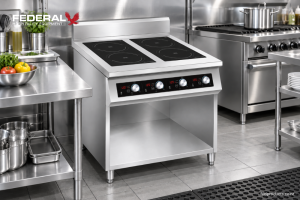
Restaurants looking for commercial induction cooking can consider the Electmax 700 Series. The range includes two-, four- and six-burner induction cookers, an induction griddle and an induction fryer, allowing businesses to match cooking capacity to the menu and available kitchen space. The original restaurant-equipment plan specifically identifies Electmax as an electric cooking option for New Zealand restaurants.
Federal Hospitality Equipment NZ's current electric cooking range also includes professional equipment from Fagor and FryMax.
Where chefs need direct flame or high-heat cooking, GASMAX provides gas cooktops, burners and chargrill options. Federal Hospitality Equipment's current GASMAX range includes different burner configurations for commercial kitchens.
How Many Burners Does a 50-Seat Restaurant Need?
There is no standard burner count for a 50-seat restaurant because the number of pans operating simultaneously depends on the menu.
A restaurant producing several sauces, pasta dishes and pan-cooked proteins at the same time may require more cooking positions than a venue whose menu relies heavily on ovens, fryers or griddles.
The Electmax 700 Series provides two-, four- and six-burner induction configurations, which illustrates why cooking capacity should be scalable rather than determined by seat count alone.
Before selecting the number of burners, map the busiest service period and estimate how many pans or cooking processes need to operate simultaneously.
Does a 50-Seat Restaurant Need a Commercial Fryer?
Only if fried food forms a meaningful part of the menu.
A restaurant serving chips, fried seafood, chicken or other high-volume fried dishes may require dedicated commercial frying capacity. Depending on demand, this could mean one fryer or separate frying capacity for different products.
If fried products are only a minor part of the menu, the restaurant should select equipment accordingly rather than automatically allocating valuable kitchen space to an oversized fryer.
Does a 50-Seat Restaurant Need a Commercial Griddle?
A griddle can be useful for restaurants serving burgers, breakfast dishes, grilled sandwiches, seafood, vegetables and other flat-top foods.
For restaurants considering induction, the Electmax 700 Series includes an induction griddle. Gas and other commercial griddle options are also available within Federal Hospitality Equipment's cooking range.
The decision should depend on how many menu items require flat-surface cooking and how heavily the griddle will be used during peak service.
When Does a Restaurant Need a Wok Range?
A wok range is primarily relevant when the menu requires repeated high-heat wok cooking.
Asian restaurants serving stir-fries, noodles and other wok-based dishes may need dedicated equipment capable of supporting that production style. The source equipment plan identifies GASMAX gas equipment and Asian wok stations as relevant options where chefs require direct flame and high heat.
A restaurant without a wok-focused menu should not purchase a wok station simply because it appears on a general commercial kitchen equipment list.
What Food Preparation Equipment Does a 50-Seat Restaurant Need?
Food-preparation equipment can reduce repetitive manual work and help the kitchen prepare ingredients more efficiently, but the exact machines required depend on the menu.
Common commercial preparation equipment can include:
- food processors;
- commercial mixers;
- blenders;
- meat slicers;
- meat mincers;
- vegetable preparation machines;
- dough-processing equipment; and
- other menu-specific preparation appliances.
A restaurant preparing sauces, dips and chopped vegetables in volume may benefit from a commercial food processor. A pizza or bakery-style operation may require a commercial mixer. A restaurant preparing meat products in-house may have different preparation requirements again.
Only equipment that supports frequent preparation tasks should be treated as essential. Start by identifying repetitive jobs such as chopping, slicing, mixing, blending or mincing, then choose commercial equipment where it can meaningfully support the restaurant's production volume.
Why Are Stainless-Steel Benches Important?
A 50-seat restaurant needs practical work areas for preparing vegetables, meat and other ingredients, assembling dishes and plating meals.
Commercial stainless steel is widely used in professional kitchens because it provides durable, practical surfaces that are suitable for frequent cleaning.
Federal Hospitality Equipment New Zealand supplies stainless-steel workbenches, benches with splashbacks, dishwasher sink benches, shelving, cabinets, handbasins, taps and related accessories.
Rather than placing benches wherever there is spare wall space, the layout should support the equipment around them. A preparation bench should be close to the refrigeration and appliances used for that task, while plating areas should connect logically with cooking and service.
How Many Preparation Benches Does a 50-Seat Restaurant Need?
Again, there is no fixed number.
A restaurant should provide enough preparation space for the tasks performed by its kitchen team without creating unnecessary congestion. Different work areas may be required for vegetables, raw ingredients, pastry, general preparation and plating depending on the menu.
Good planning should also support appropriate separation between raw-food preparation and ready-to-eat food handling.
Does a 50-Seat Restaurant Need a Commercial Dishwasher?
For most 50-seat restaurants, a commercial dishwasher is a practical part of the kitchen because dishwashing demand can rise very quickly during service.
Fifty customers can generate far more than 50 items requiring washing. Plates, side plates, bowls, glasses, cups, cutlery, preparation utensils and cookware can all enter the wash area during a single sitting.
Manual washing can therefore become a bottleneck, particularly when tables are turning and clean tableware needs to return to service quickly.
The original equipment plan recommends positioning the commercial dishwasher near the dirty-dish collection area while keeping the wash zone separated from clean food-preparation areas. It also identifies a suitable sink, pre-rinse arrangement and drainage as part of the setup.
What Beverage Equipment Does a 50-Seat Restaurant Need?
Beverage equipment depends entirely on what the restaurant serves.
A restaurant offering coffee throughout the day will normally need a commercial coffee machine and grinder. A venue offering smoothies, cocktails or blended beverages may also need commercial blenders or ice-crushing equipment.
Where a restaurant serves a significant volume of cold beverages, an ice machine can become an important part of the beverage station.
Federal Hospitality Equipment NZ's range includes coffee machines, coffee grinders, ice makers, blenders, ice crushers and juice dispensers among its beverage equipment options.
Does a 50-Seat Restaurant Need an Ice Machine?
Not every restaurant needs the same ice-production capacity, but venues serving a significant volume of cold drinks, cocktails or iced beverages should consider whether purchasing ice externally or relying on small-scale ice production will support peak service.
Ice-machine capacity should be planned around daily demand and peak beverage periods rather than restaurant seating alone.
Does a Restaurant Need Separate Beverage Refrigeration?
Separate beverage refrigeration can be useful where drinks form a significant part of service because it prevents staff from repeatedly accessing food-storage refrigerators for bottles, cans and mixers.
Federal Hospitality Equipment NZ currently offers commercial bar refrigeration from brands including FED-X, Thermaster and Blizzard.
For restaurants with bar service, positioning beverage refrigeration close to the bar can support a more efficient service workflow.
What Ventilation Does a 50-Seat Restaurant Need?
Ventilation requirements depend on the cooking equipment, menu and kitchen design.
Commercial cooking can produce heat, steam, smoke, grease and vapour, so appropriate ventilation and extraction need to be considered during kitchen planning.
This is particularly important before finalising gas cooktops, fryers, chargrills, wok stations and other high-output cooking equipment.
The original equipment plan identifies the exhaust hood and ventilation system as a core restaurant-kitchen area and also notes that New Zealand operators should consider ventilation, electrical or gas requirements, water supply and drainage before installation.
How Should a 50-Seat Restaurant Kitchen Be Laid Out?
A practical kitchen layout should follow the movement of food through the operation rather than simply filling available floor space with appliances.
A logical sequence is:
Receiving → Storage → Preparation → Cooking → Plating → Service → Dishwashing → Waste Handling
When these areas connect logically, staff can spend less time walking backwards and forwards across the kitchen.
For example, bulk refrigeration should be accessible from receiving and preparation areas. Prep refrigeration should sit near the station using those ingredients. Cooking equipment should connect with preparation and plating, while the dishwashing area should be positioned around the return path for dirty tableware.
Why Does Workflow Matter as Much as Equipment Capacity?
A kitchen can contain high-capacity equipment and still operate inefficiently if staff constantly cross each other's paths.
Imagine placing the main refrigerator at the opposite end of the kitchen from the preparation station. Staff may make dozens of unnecessary trips during a busy service. Similarly, placing the dishwasher in a position where dirty dishes pass through clean preparation areas can create an impractical workflow.
Equipment selection and kitchen layout should therefore be planned together.
| Planning Priority | Why It Matters |
|---|---|
| Menu Requirements | Prevents unnecessary appliance purchases |
| Peak Service Volume | Helps determine realistic production capacity |
| Kitchen Footprint | Helps prevent overcrowding |
| Staff Movement | Reduces unnecessary walking and crossing |
| Refrigeration Access | Keeps frequently used ingredients closer to preparation |
| Cleaning Workflow | Supports practical dirty-to-clean movement |
| Future Growth | Allows reasonable capacity beyond immediate demand |
How Does the Menu Change the Equipment Package?
This is one of the most important questions when planning a restaurant kitchen. A 50-seat capacity does not create a universal equipment list.
50-Seat Bistro
A compact bistro may prioritise an upright fridge, underbench refrigeration, commercial cooktop, oven, griddle or chargrill, food-preparation equipment, dishwasher and a relatively compact beverage station.
50-Seat Asian Restaurant
An Asian restaurant may require dedicated wok equipment, high-output gas burners, substantial refrigerated ingredient storage, preparation benches and a dishwashing system capable of supporting high table turnover.
50-Seat Steakhouse
A steak-focused restaurant may place more emphasis on chargrilling, griddle cooking, refrigerated meat storage, preparation surfaces and appropriate extraction.
50-Seat All-Day Café
An all-day café may need a balanced combination of breakfast cooking equipment, refrigeration, coffee equipment, grinders, blenders, ice production and food display.
50-Seat Seafood Restaurant
A seafood restaurant may require substantial chilled storage together with cooking equipment appropriate to grilled, fried or pan-cooked seafood dishes.
The important principle is that the menu determines the equipment mix.
What Equipment Brands Can a New Zealand Restaurant Consider?
Federal Hospitality Equipment New Zealand currently carries several commercial equipment brands across relevant restaurant-kitchen categories.
FED-X Commercial Refrigeration
FED-X is represented across commercial refrigeration, including upright fridges and freezers, stainless-steel bench refrigeration and preparation refrigeration. This makes the brand relevant to both bulk ingredient storage and workstation refrigeration.
Thermaster Commercial Refrigeration
Thermaster is available across upright, preparation and beverage refrigeration. Current FHE NZ ranges include Thermaster upright drink fridges, commercial storage freezers, cold preparation units and bar refrigeration.
Electmax Commercial Induction Cooking
Electmax is particularly relevant to restaurants considering commercial induction. The Electmax 700 Series includes different induction-cooker capacities along with griddle and fryer options, allowing operators to configure the cooking line around the menu.
GASMAX Commercial Gas Cooking
GASMAX provides gas cooking options including commercial burner tops, cooktops and chargrills, making it relevant where direct gas cooking forms part of the restaurant's production method.
Fagor Professional Cooking Equipment
Fagor is represented in Federal Hospitality Equipment NZ's professional cooking range, including the Kore commercial cooking series.
FryMax Commercial Cooking Equipment
FryMax also appears within the current electric cooking range, providing additional options for specific commercial cooking applications.
Brand should be considered together with equipment type, capacity, dimensions, available utilities and the workload expected from the appliance. A well-known brand does not remove the need to select the correct model for the operation.
What Equipment Should a 50-Seat Restaurant Buy First?
Equipment purchasing should follow operational priorities.
Start with the equipment required for food storage and the restaurant's core menu production. This normally means establishing refrigeration and cooking requirements first.
Next, determine preparation equipment and stainless-steel work areas so ingredients can move efficiently between storage and cooking.
Dishwashing should be planned early because it affects water, drainage, sink configuration and the dirty-to-clean workflow.
Beverage equipment, display equipment and other specialist appliances should then be added according to the restaurant concept.
What Should You Check Before Ordering Restaurant Equipment?
- What is the complete menu?
- How many covers are expected during peak service?
- Will the restaurant offer takeaway or delivery?
- How frequently will ingredients be delivered?
- How much chilled and frozen storage is required?
- Which cooking methods are used most frequently?
- How many cooking processes need to run simultaneously?
- Is gas, electric or induction more appropriate for the menu?
- What electrical supply is available?
- Is natural gas or LPG required?
- What ventilation and extraction are needed?
- How much stainless-steel preparation space is required?
- Which food-preparation tasks need commercial machinery?
- What dishwashing capacity is required during peak service?
- What water supply and drainage are available?
- Does the restaurant need a coffee machine?
- Is commercial ice production required?
- Does the restaurant need dedicated beverage refrigeration?
- Can staff move logically between storage, preparation, cooking and plating?
- Is there sufficient access for equipment delivery and servicing?
- What realistic future growth should be allowed for?
What Are Common Equipment Planning Mistakes for a 50-Seat Restaurant?
1. Buying Equipment Based Only on Seat Count
Seats do not reveal table turnover, takeaway volume or menu complexity. Production requirements should determine capacity.
2. Buying Before Finalising the Menu
The menu should determine the cooking and preparation equipment rather than forcing the menu to fit equipment already purchased.
3. Underestimating Refrigeration
Insufficient refrigerated storage can create overcrowding and make ingredient organisation more difficult.
4. Choosing the Largest Equipment Automatically
Larger equipment consumes valuable kitchen space. Capacity should reflect realistic workload rather than simply choosing the biggest available model.
5. Ignoring Workflow
Equipment can have suitable capacity but still slow service if it is positioned poorly.
6. Forgetting Dishwashing Capacity
Dirty plates, glasses and cookware can accumulate quickly during peak service, making the wash area a potential bottleneck.
7. Forgetting Ventilation and Utilities
Gas, electrical capacity, water, drainage and ventilation requirements should be understood before equipment is ordered.
8. Buying Specialist Equipment That the Menu Rarely Uses
Every appliance occupies space and ties up capital. Specialist equipment should have a clear role in regular production.
9. Ignoring Future Growth
Equipment should provide enough capacity for realistic growth without substantially oversizing the kitchen from day one.
What Is the Best Equipment Package for a 50-Seat Restaurant?
There is no single package that is best for every 50-seat restaurant.
A practical starting configuration may include adequate upright refrigeration, workstation refrigeration, freezer capacity where required, menu-specific cooking appliances, stainless-steel preparation areas, food-preparation equipment, a commercial dishwasher and sink arrangement, appropriate storage, ventilation and the beverage equipment required by the restaurant concept.
From there, the package should be adapted. A steakhouse might prioritise chargrilling. An Asian restaurant may need wok equipment. A café-style restaurant may allocate more space to coffee and beverage production. A venue with extensive fried food may require greater fryer capacity.
No. The foundation is similar—refrigeration, cooking, preparation, stainless-steel work areas, dishwashing, storage, beverage equipment and ventilation—but the individual appliances and capacities should be selected according to the menu, peak workload and available kitchen space.
Why Consider Federal Hospitality Equipment New Zealand?
Federal Hospitality Equipment New Zealand supplies commercial equipment across the main areas required for professional restaurant kitchens, including refrigeration, cooking, stainless steel, food preparation, catering and beverage equipment.
Relevant brands across the current range include FED-X, Thermaster, Electmax, GASMAX, Fagor and FryMax, allowing restaurant operators to compare different equipment types and capacities according to their kitchen requirements.
Federal Hospitality Equipment has Auckland and Christchurch locations and supplies hospitality equipment across New Zealand.
For a 50-seat restaurant, the most useful approach is not to purchase a predetermined list of appliances. Start with the menu and production requirements, establish the kitchen workflow and utilities, and then select equipment with suitable capacity for the actual operation.
Conclusion: What Does a 50-Seat Restaurant Really Need?
A 50-seat restaurant needs a commercial kitchen capable of supporting the complete journey from ingredient storage to finished service. In most cases, that means reliable commercial refrigeration, menu-specific cooking equipment, food-preparation appliances, stainless-steel work areas, efficient dishwashing, appropriate storage, beverage equipment and ventilation.
However, the number of seats should only be the starting point. A 50-seat bistro, steakhouse, Asian restaurant, seafood venue and all-day café can each require a different equipment package.
Refrigeration should be sized according to stock levels and delivery frequency. Cooking appliances should match the menu and number of dishes being produced simultaneously. Preparation equipment should support tasks staff perform regularly. Stainless-steel work areas should connect logically with storage and cooking, while the dishwashing zone needs enough capacity to prevent dirty tableware from becoming a service bottleneck.
The restaurant should also consider gas and electrical requirements, water, drainage, ventilation, staff movement, service access and future growth before installation. These planning factors are specifically identified in the original restaurant equipment framework.
Federal Hospitality Equipment New Zealand offers equipment across these areas, with relevant brands including FED-X, Thermaster, Electmax, GASMAX, Fagor and FryMax.
The best 50-seat restaurant kitchen is therefore not the one with the most equipment. It is the one where each appliance has a clear purpose, capacity matches the workload, and refrigeration, preparation, cooking, plating, beverage service and dishwashing work together efficiently.
Frequently Asked Questions
What equipment does a 50-seat restaurant need?
A typical 50-seat restaurant needs commercial refrigeration, cooking appliances, food-preparation equipment, stainless-steel work areas, storage, a commercial dishwasher and sink setup, beverage equipment and appropriate ventilation.
How many fridges does a 50-seat restaurant need?
There is no fixed number. Many restaurants can benefit from combining bulk upright refrigeration with prep or underbench refrigeration positioned near working stations. The required capacity depends on menu, stock levels and delivery frequency.
What size fridge does a 50-seat restaurant need?
Fridge capacity should be based on peak stock requirements rather than seat count alone. Consider the menu, amount of fresh food stored and frequency of deliveries.
Does a 50-seat restaurant need a freezer?
A commercial freezer is appropriate where the menu uses frozen ingredients or the restaurant requires longer-term frozen storage.
What cooking equipment does a 50-seat restaurant need?
Common options include commercial cooktops, ovens, fryers, griddles, salamanders and wok equipment, but the actual combination should be determined by the menu.
How many burners does a 50-seat restaurant need?
There is no standard burner count. Calculate how many pans need to operate simultaneously during peak service and select cooking capacity accordingly.
Should a 50-seat restaurant use gas or induction?
Either can be suitable depending on the menu, cooking methods, utilities and kitchen design. Electmax provides commercial induction options, while GASMAX offers gas cooking equipment for restaurants requiring direct flame.
Does a 50-seat restaurant need a commercial fryer?
A fryer is appropriate where fried foods form a meaningful part of the menu. Required capacity should reflect the volume produced during peak service.
Does a 50-seat restaurant need a griddle?
A griddle can be useful for burgers, breakfast dishes, seafood, vegetables and other flat-top cooking, but it should only be included when the menu justifies it.
Does a 50-seat restaurant need a commercial dishwasher?
For most operations of this size, a commercial dishwasher can help prevent washing plates, glassware, cutlery and kitchenware from becoming a service bottleneck.
What food-preparation equipment does a restaurant need?
This depends on the menu. Food processors, mixers, blenders, slicers, mincers and other commercial preparation appliances should be selected according to tasks performed frequently.
Why are stainless-steel benches important in a restaurant kitchen?
They provide durable, practical work areas for preparation, plating and other kitchen tasks and can be positioned to support an efficient workflow.
Does a 50-seat restaurant need a coffee machine?
Only if coffee forms part of the beverage service. Restaurants serving coffee regularly should consider a commercial coffee machine and grinder sized for expected demand.
Does a 50-seat restaurant need an ice machine?
An ice machine can be important where cold beverages, cocktails or other drinks create regular ice demand. Capacity should reflect daily and peak beverage requirements.
What refrigeration brands does Federal Hospitality Equipment NZ offer?
Current FHE NZ commercial refrigeration includes brands such as FED-X and Thermaster across upright, workbench, preparation and other refrigeration applications.
What commercial cooking brands does FHE NZ offer?
Relevant current cooking brands include Electmax, GASMAX, Fagor and FryMax across induction, gas and electric commercial cooking applications.
How should a 50-seat restaurant kitchen be laid out?
A practical flow generally moves from receiving and storage to preparation, cooking, plating and service, followed by dishwashing and waste handling.
Should I choose restaurant equipment based on seats or menu?
The menu and peak production requirements should carry more weight than seat count alone. Seat numbers do not account for table turnover, takeaway orders or differences in menu complexity.
What should I check before buying restaurant equipment?
Check menu requirements, peak service volume, refrigeration capacity, kitchen dimensions, staff workflow, gas or electrical requirements, ventilation, water, drainage, delivery access and servicing requirements.
Is there one standard equipment package for every 50-seat restaurant?
No. The basic operational categories remain similar, but a bistro, Asian restaurant, steakhouse, seafood restaurant and all-day café can require very different appliances and capacities.