Customer Helpline:





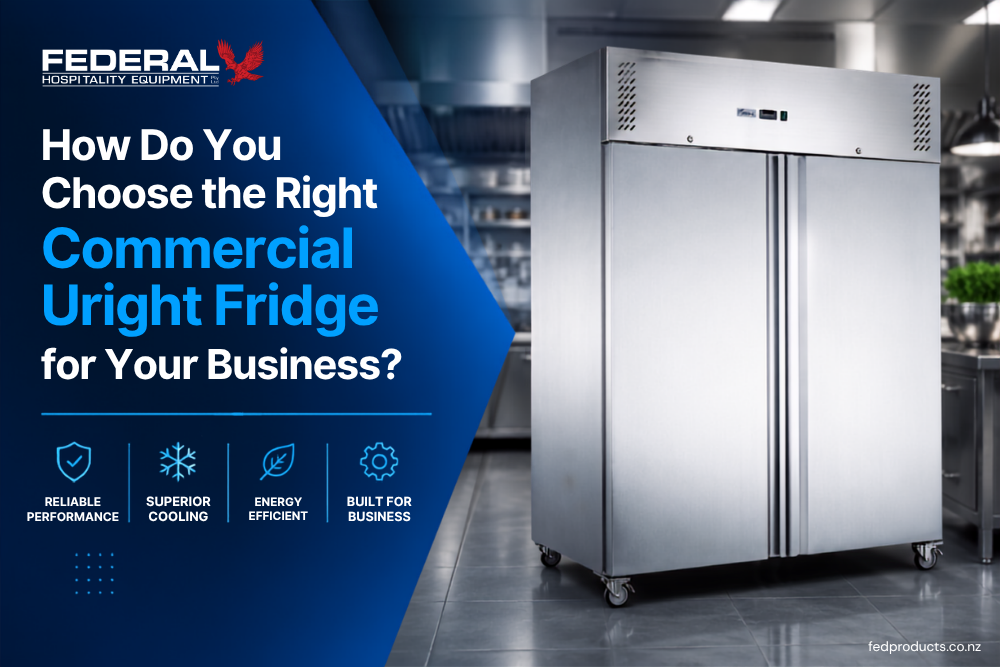
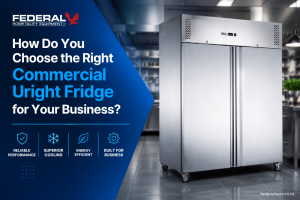
Choosing the right commercial upright fridge is an important decision for any New Zealand food or hospitality business. A commercial fridge may hold milk for hundreds of coffees, fresh ingredients for restaurant service, prepared food for a busy kitchen, or bottled and packaged drinks ready for customers.
Because refrigeration is used continuously throughout the working day, the right fridge affects much more than cold storage. Its size, internal layout, door configuration and position can influence how quickly staff find ingredients, how efficiently stock is organised, how much kitchen space is available and how smoothly preparation and service operate.
The biggest commercial fridge is not automatically the best choice. A refrigerator that is too small may become overcrowded during busy periods, while an unnecessarily large cabinet can take up valuable floor space without delivering a practical benefit to the business.
Door configuration matters too. A solid-door commercial fridge used for back-of-house ingredient storage serves a different purpose from a glass-door upright refrigerator designed to keep drinks and packaged products visible.
The most practical approach is to look at the complete requirement: what you need to refrigerate, how much usable storage you require, whether you need a single or double door, where the fridge will be installed, how often it will be accessed and how it will fit into your everyday workflow.
This guide from Federal Hospitality Equipment New Zealand explains the main factors cafés, restaurants, bars, bakeries, convenience stores and other foodservice businesses should consider when choosing commercial upright refrigeration.
Start with what you actually need to store. Then consider usable capacity, single or double doors, solid or glass doors, available floor space, internal shelving, door clearance, ventilation, cooling features, cleaning access and daily workflow. A good commercial fridge should provide enough refrigerated storage for normal and predictable busy periods without unnecessarily occupying valuable working space.
What Should You Consider Before Buying a Commercial Upright Fridge?
Before comparing individual models, consider how refrigeration actually works within your business. Two restaurants with similar seating capacities can have completely different cold-storage requirements depending on their menus, delivery schedules, preparation methods and stock turnover.
A café may mainly need milk, dairy products, fruit, vegetables and prepared ingredients. A full-service restaurant could require significantly more space for meat, sauces, produce and mise en place, while a convenience store may prioritise visibility of bottled and packaged products.
Start by answering a few practical questions:
- What food or beverages will you store?
- How much stock do you normally hold?
- How much additional capacity is required during busy periods?
- Will the fridge be used back of house or where customers can see it?
- Would solid or glass doors be more practical?
- Would a single-door or double-door fridge better suit your workload?
- How much floor space is available?
- How frequently will staff access the refrigerator?
- What type of containers and packaging need to fit on the shelves?
How Much Commercial Fridge Capacity Do You Really Need?
Capacity is important, but litres should not be considered in isolation. A refrigerator can look impressive on a specification sheet yet still be unsuitable if its internal dimensions and shelving do not accommodate the containers, bottles or ingredients your business regularly stores.
Look at the products occupying your current refrigeration. Milk bottles require different shelf spacing from gastronorm containers. Bottled drinks, prepared sauces, produce boxes and packaged food all use internal space differently.
The objective is therefore not simply to purchase a certain number of litres. It is to obtain enough usable refrigerated space for the way your business actually operates.
No. Compare capacity together with internal dimensions, shelving, door configuration and the products you need to store. A well-organised smaller cabinet can sometimes be more practical than a larger fridge with an unsuitable internal layout.
For more compact solid-door requirements, the FED-X XR400SS 350L provides a single-door option. Businesses requiring greater single-door capacity can consider the FED-X XR600SS 570L, while higher-volume operations can compare larger commercial configurations such as the FED-X XURC600SFV and FED-X XURC1200SFV.
How Much Spare Refrigeration Capacity Should You Allow?
A commercial refrigerator should have enough capacity for normal trading plus predictable increases in stock during busy periods. If every shelf is completely packed during ordinary service, staff may struggle to organise products effectively and locate ingredients quickly.
At the same time, buying substantially more capacity than the business realistically requires can occupy valuable kitchen space. The goal should be sensible flexibility rather than excessive spare capacity.
Consider weekly delivery patterns as well. A restaurant receiving fresh deliveries several times a week may require a different amount of storage from a business that receives larger deliveries less frequently.
Should You Choose a Solid-Door or Glass-Door Commercial Fridge?
Neither configuration is universally better. The right door type depends primarily on what the refrigerator is expected to do.
A solid-door commercial fridge is generally more suited to back-of-house food and ingredient storage, where customers do not need to see the contents. A glass-door commercial fridge becomes more useful when product visibility is important, such as displaying drinks or packaged refrigerated products.
| Consideration | Solid-Door Fridge | Glass-Door Fridge |
|---|---|---|
| Typical Position | Back of house | Front of house or retail areas |
| Main Purpose | Food and ingredient storage | Beverage and packaged-product display |
| Visibility | Contents concealed | Products visible through the door |
| Common Applications | Restaurants, cafés, bakeries and commercial kitchens | Cafés, bars, convenience stores and retail environments |
| Door Configurations | Single or double door | Single, double or triple glass door |
| Main Buying Priority | Storage, access and organisation | Refrigeration plus product visibility |
When Should You Choose a Solid-Door Commercial Fridge?
Solid-door upright refrigerators are particularly practical for back-of-house commercial kitchens. Staff generally know what is stored in the cabinet, so there is little need for customers to see the contents. Instead, the priorities are usable storage, convenient access and sensible organisation.
A compact café or bakery may find a smaller single solid-door fridge sufficient for milk, ingredients and prepared products. A restaurant handling several food categories or larger preparation volumes may need a higher-capacity single-door or double-door refrigerator.
For smaller commercial refrigeration requirements, the FED-X XR400SS 350L provides a single solid-door configuration, while the FED-X XR600SS 570L offers greater capacity within a single-door format. Businesses requiring substantially more storage can compare larger FED-X configurations, including the XURC1200SFV two full-door upright fridge.
When Is a Glass-Door Commercial Fridge a Better Choice?
A glass-door fridge becomes particularly useful when seeing the product before opening the refrigerator adds practical or merchandising value.
For a convenience store, customers can view bottled drinks and packaged refrigerated products without opening the cabinet. In a café or bar, staff can quickly see which drinks are available and where they are positioned.
Federal Hospitality Equipment New Zealand offers glass-door Thermaster upright refrigeration in several configurations. The Thermaster LG-370BP provides a single glass-door option, while the LG-730BP offers two glass doors. Larger requirements can be matched with configurations such as the LG-1200P and LG-1203BP.
Choose a solid-door fridge when the main purpose is back-of-house food and ingredient storage. Consider a glass-door fridge when customers or staff benefit from seeing bottled drinks or packaged products without opening the cabinet.
Should You Choose a Single-Door or Double-Door Commercial Upright Fridge?
Choosing between a single-door and double-door commercial upright fridge is not simply a matter of buying the largest refrigerator your kitchen or budget can accommodate. The better option depends on how much refrigerated stock you hold, how quickly it moves, how many staff need access and how much usable floor space is available.
A single-door upright fridge can be an excellent choice for a café, bakery, takeaway or smaller restaurant with moderate refrigeration requirements. Its narrower footprint can make it easier to incorporate into compact preparation areas while still taking advantage of vertical storage.
A double-door refrigerator becomes more practical as stock volumes increase. The additional internal space can also make it easier to separate different ingredient categories rather than stacking unrelated products together simply because there is nowhere else to put them.
When Should You Choose a Single-Door Upright Fridge?
A single-door commercial fridge makes sense when refrigerated stock requirements are moderate and floor space is valuable. For many smaller cafés, bakeries and food businesses, a properly sized single-door unit can provide all the storage required without unnecessarily reducing circulation or preparation space.
For example, a café mainly storing milk, produce, prepared ingredients and smaller quantities of refrigerated food may not gain much from a large double-door cabinet if its normal stock comfortably fits into a single-door unit.
A single-door upright fridge is worth considering for cafés, bakeries, takeaways and smaller commercial kitchens where refrigerated stock is moderate and floor space is limited. It can provide useful vertical storage while maintaining a comparatively compact footprint.
Which Single-Door FED-X Upright Fridges Should You Consider?
For more compact commercial refrigeration requirements, consider the FED-X XR400SS 350L. Its single solid-door configuration can suit businesses that need straightforward back-of-house refrigeration without moving immediately to a large cabinet.
Where greater storage is required but a single-door format remains preferable, the FED-X XR600SS 570L provides additional capacity. This may suit a busier café, restaurant, bakery or food-preparation operation that needs more refrigerated space while still wanting a single-door configuration.
The FED-X XURC600SFV provides another single full-door option for higher-volume commercial storage requirements. The final choice should be based on actual product storage, dimensions and workflow rather than capacity alone.
When Should You Choose a Double-Door Upright Fridge?
A double-door commercial upright fridge is generally more appropriate when refrigerated storage plays a major role in daily kitchen operations. Restaurants, catering businesses and high-volume foodservice operations may need to hold several ingredient categories simultaneously, particularly when significant preparation takes place before lunch or dinner service.
The advantage is not simply additional litres. Greater internal space can help staff organise products more logically. Meat, dairy, sauces, vegetables and prepared ingredients can be arranged in defined areas according to the business's storage and food-handling procedures.
This becomes particularly useful when several employees need refrigerated ingredients during service. A cabinet that technically provides enough litres can still slow down the kitchen if products are difficult to find or retrieve.
Consider a double-door upright fridge when your business regularly stores larger quantities of refrigerated food, needs more room to organise different product categories or has several staff accessing cold storage during busy periods. It can be particularly useful for restaurants, catering kitchens and higher-volume food operations.
Which Double-Door FED-X Upright Fridge Should You Consider?
For businesses requiring substantially greater back-of-house refrigeration, the FED-X XURC1200SFV provides a two full-door configuration designed for larger commercial storage requirements.
This type of capacity can be more practical for restaurants and high-volume kitchens where several categories of refrigerated ingredients need to be available throughout preparation and service.
Before selecting a double-door fridge, however, check the complete installation area. The unit must not only fit physically; there should also be sufficient space for doors to open, staff to work around the refrigerator and the required ventilation clearances to be maintained.
Single Door or Double Door: Which One Should Your Business Choose?
| If Your Business... | Consider | Why? |
|---|---|---|
| Has limited kitchen floor space | Single door | Provides vertical refrigerated storage with a more compact footprint. |
| Stores moderate quantities of ingredients | Single door | May provide sufficient capacity without unnecessarily occupying additional floor space. |
| Needs more capacity but prefers one door | Larger single door | Can increase storage without immediately moving to a two-door cabinet. |
| Stores several ingredient categories | Double door | Additional internal space can make stock organisation easier. |
| Has several staff accessing refrigeration | Double door | Greater storage and organisation can better support busy service periods. |
| Runs a high-volume restaurant or catering kitchen | Double door | Larger refrigerated capacity can better support higher stock and preparation volumes. |
How Should You Measure the Space for a Commercial Upright Fridge?
Commercial upright refrigeration makes good use of vertical space, but the installation needs to be measured carefully. Measuring only the width of an empty gap is not enough.
Check the complete cabinet dimensions together with door movement, nearby benches, walls and equipment. Staff also need sufficient room to load, unload and clean the fridge without obstructing other work areas.
- Available width
- Available depth
- Available height
- Door-opening clearance
- Space around adjacent benches and appliances
- Required ventilation clearance
- Electrical connection location
- Cleaning access
- Service access
- Access route into the premises
Why Does Door-Opening Clearance Matter?
A commercial refrigerator can technically fit into the allocated floor area and still be completely impractical if its doors cannot open sufficiently.
Consider a fridge installed tightly beside another appliance or preparation bench. The cabinet may fit perfectly, but the door could strike the neighbouring equipment before opening far enough for staff to load large containers or remove shelves.
Think about real use during a busy service. Employees may approach the fridge carrying containers, open it while another staff member is working nearby, or need quick access to frequently used ingredients. The door swing should support these movements rather than create another obstacle.
Why Does a Commercial Upright Fridge Need Proper Ventilation?
Commercial refrigeration requires appropriate airflow around the equipment. Therefore, an installation area needs to satisfy the requirements of the particular refrigerator rather than simply being large enough to contain the cabinet.
This becomes particularly important in compact kitchens where operators may be tempted to fit refrigeration tightly between other appliances or against surrounding surfaces.
Always check the manufacturer's installation requirements for the particular model and ensure the required ventilation clearance can be maintained.
How Does Your Kitchen Environment Affect Commercial Fridge Selection?
A commercial kitchen can be a demanding environment for refrigeration. Cooking appliances produce heat, refrigerator doors may be opened repeatedly, and equipment can experience intense use during peak service periods.
Consider where the fridge will operate in relation to cooking equipment, preparation benches and high-traffic areas. A refrigerator positioned directly in a congested workflow may be inconvenient even if the dimensions are technically correct.
Think about the frequency of door opening as well. A fridge containing frequently used ingredients may be accessed many times during a service, making positioning and internal organisation especially important.
How Can Your Commercial Fridge Improve Kitchen Workflow?
The right refrigerator should make everyday work easier, not simply provide cold space. Think about how ingredients move from refrigerated storage to preparation and then into cooking or service.
Frequently used products should be accessible without requiring staff to repeatedly cross the kitchen or interrupt another workstation. In a high-volume operation, a larger double-door fridge can help by providing additional room to organise different ingredient groups.
In a smaller operation, however, a compact refrigerator positioned close to the relevant preparation area may provide a better workflow than a larger unit located somewhere inconvenient simply because that was the only place it would fit.
Position the fridge where staff can access frequently used ingredients efficiently without blocking preparation areas, walkways or other equipment. The location must also provide the ventilation, door clearance and service access required for the particular refrigerator.
Why Is Adjustable Shelving Important in a Commercial Upright Fridge?
Internal shelving has a major influence on how effectively refrigerator capacity can be used. Different businesses store very different containers, and fixed shelf positions may not suit every application.
A café may need tall spaces for milk bottles alongside smaller prepared ingredients. A restaurant might need room for larger containers containing sauces, vegetables and mise en place. Adjustable shelves allow the internal arrangement to be adapted to these requirements.
Good shelf organisation also helps staff locate products more quickly. Capacity is most useful when employees can see, organise and retrieve the stock stored inside the cabinet.
What Cooling Features Should You Look for in a Commercial Upright Fridge?
Depending on the refrigerator model, commercial upright units may include features such as fan-forced cooling, digital temperature controls and automatic defrost.
Fan-forced cooling can form part of the cabinet's temperature-management system, while digital controls can make routine temperature checking more convenient for staff. Automatic defrost can also reduce the amount of manual intervention required as part of everyday operation.
Features should still be assessed together with the refrigerator's intended application, operating environment and manufacturer specifications rather than being considered in isolation.
Depending on the model, useful features can include fan-forced cooling, digital temperature controls and automatic defrost. Compare these features together with storage requirements, operating conditions and the products that will be refrigerated.
Why Is Temperature Monitoring Important?
Commercial refrigeration forms part of a business's wider food-storage procedures. The refrigerator needs to provide appropriate refrigerated conditions for the products being stored, while the business needs suitable processes for temperature monitoring, stock management and cleaning.
A digital temperature display can make routine checks more convenient, but technology should complement appropriate food-handling procedures rather than replace them.
Why Does Durability Matter in Commercial Refrigeration?
A commercial upright fridge is used very differently from a typical household refrigerator. Doors may be opened repeatedly, shelves loaded and unloaded, stock moved throughout the day and the interior cleaned regularly.
Construction therefore matters. Stainless steel solid-door models are commonly suited to demanding back-of-house environments and can integrate well with regular commercial kitchen cleaning routines.
When comparing equipment, consider how the refrigerator will cope with your actual operating environment rather than looking only at its appearance when new.
How Important Is Ease of Cleaning?
Cleaning access should be considered before purchasing the refrigerator. Staff need to be able to clean shelves, internal surfaces, corners and frequently handled areas as part of normal kitchen procedures.
Adjustable or removable shelving can also help by making different parts of the cabinet easier to access. A fridge that is simple to organise and clean can be much more practical over years of everyday use.
How Can the Right Fridge Support Efficient Operation?
Efficiency starts with choosing equipment that matches the actual application. An unnecessarily large refrigerator may provide capacity that is rarely used, while a fridge that is too small can create storage pressure and poor organisation.
Installation matters as well. Appropriate ventilation, logical positioning and practical shelf organisation all contribute to how effectively the equipment can be used in everyday operation.
Instead of treating efficiency as one isolated specification, consider the complete setup: capacity, placement, ventilation, organisation and how frequently staff need to access the cabinet.
Which Commercial Upright Fridge Is Best for a Café?
A café generally needs convenient refrigerated storage for milk, dairy products, produce, prepared ingredients and other products used repeatedly throughout the day. Because many cafés operate from relatively compact premises, footprint and accessibility can be just as important as total capacity.
For a smaller café with moderate back-of-house storage requirements, a single solid-door refrigerator may be the most practical starting point. The FED-X XR400SS 350L can suit more compact requirements, while the FED-X XR600SS 570L provides additional capacity where greater single-door storage is needed.
If the café sells bottled drinks or packaged refrigerated products directly to customers, a separate glass-door fridge may make more sense for that part of the operation because customers can see the available products.
Which Commercial Upright Fridge Is Best for a Restaurant?
Restaurants often have more complex refrigeration requirements because several ingredient categories need to be stored and accessed throughout preparation and service.
A smaller restaurant may still operate effectively with a large single-door refrigerator if stock levels are moderate. As menu complexity and preparation volumes increase, however, a double-door cabinet can provide additional capacity and make product organisation easier.
For larger commercial storage requirements, the FED-X XURC1200SFV two full-door refrigerator can be considered where a high-capacity configuration better matches the operation.
A smaller restaurant with moderate refrigerated stock may be well served by a large single-door fridge. A busier restaurant storing several ingredient categories or larger preparation volumes may benefit more from a double-door upright fridge with additional capacity and organisational space.
Which Commercial Upright Fridge Is Best for a Bar or Pub?
Bars and pubs commonly need substantial refrigerated beverage storage, making visibility and quick stock identification important considerations.
A glass-door upright fridge allows staff to see bottled and canned beverages before opening the cabinet. This can be useful during busy service when employees need to identify products quickly.
The required configuration depends on stock volume. A smaller operation may only need a single glass-door unit, while busier venues can consider double-door or larger configurations.
Which Commercial Upright Fridge Is Best for a Convenience Store?
For convenience stores, refrigeration often has a dual role: keeping products refrigerated while also displaying them to customers.
Glass-door upright refrigerators are therefore particularly useful for bottled beverages and packaged refrigerated products. Customers can see the available range before opening the door, while the vertical cabinet provides substantial display space.
Depending on product range and sales volume, businesses can compare single-, double- and triple-glass-door configurations such as the Thermaster LG-370BP, LG-730BP, LG-1200P and LG-1203BP.
Which FED-X Solid-Door Upright Fridges Can You Consider?
| Model | Configuration | Practical Application |
|---|---|---|
| FED-X XR400SS | Single solid door, 350L | Compact commercial refrigeration requirements |
| FED-X XR600SS | Single solid door, 570L | Greater capacity while retaining a single-door format |
| FED-X XURC600SFV | Single full door | Higher-volume single-door commercial storage |
| FED-X XURC1200SFV | Two full doors | Larger and higher-volume commercial refrigeration requirements |
Which Thermaster Glass-Door Upright Fridges Can You Consider?
| Model | Configuration | Potential Application |
|---|---|---|
| Thermaster LG-370BP | Single glass door | Smaller beverage display requirements |
| Thermaster LG-730BP | Two glass doors | Medium-to-large beverage display |
| Thermaster LG-1200P | Large two-glass-door configuration | Higher-volume customer-facing display |
| Thermaster LG-1203BP | Three glass doors | Large beverage display requirements |
What Are the Most Common Mistakes When Buying a Commercial Upright Fridge?
1. Choosing by Litres Alone
Capacity does not tell the whole story. Internal dimensions, shelf positions and the types of products being stored determine how useful the available space will actually be.
2. Buying a Fridge That Is Too Small
Insufficient capacity can lead to overcrowding and make stock difficult to organise during busy periods.
3. Buying a Fridge That Is Unnecessarily Large
Oversized refrigeration can occupy valuable kitchen space while providing capacity that the business rarely uses.
4. Choosing the Wrong Door Type
Solid doors generally make more sense for back-of-house ingredient storage, while glass doors are useful when product visibility is part of the requirement.
5. Forgetting Door Clearance
A refrigerator may fit into the allocated space but still be inconvenient if the door cannot open properly around adjacent equipment.
6. Ignoring Ventilation Requirements
Commercial refrigeration requires appropriate airflow according to the installation requirements of the specific model.
7. Ignoring Shelf Organisation
Poor internal organisation can make even a large refrigerator frustrating and inefficient to use.
8. Forgetting Cleaning Access
Staff need convenient access to internal surfaces, shelves and other areas that form part of regular cleaning procedures.
9. Ignoring Kitchen Traffic
Fridge doors and staff accessing the cabinet should not unnecessarily interfere with preparation areas or walkways.
10. Choosing for Today Without Considering Predictable Growth
Buy for genuine current requirements while allowing sensible flexibility for predictable increases in trading volume. Avoid both immediate undersizing and speculative oversizing.
What Should You Check Before Buying a Commercial Upright Fridge?
- What food or beverages will be stored?
- How much usable refrigerated capacity is genuinely required?
- What happens to stock levels during busy periods?
- Is the refrigerator for back-of-house or customer-facing use?
- Would solid or glass doors be more suitable?
- Would a single or double door better support the workflow?
- What width, depth and height are available?
- Can the doors open fully?
- Will the doors interfere with nearby equipment?
- Can the required ventilation clearances be maintained?
- Does the shelving suit your containers and products?
- Would adjustable shelving improve organisation?
- How frequently will staff access the fridge?
- What cooling and temperature-control features are provided?
- Is the interior practical to clean?
- Does the construction suit commercial use?
- Can the equipment be accessed for servicing?
- Will the refrigerator improve rather than obstruct workflow?
Why Consider Federal Hospitality Equipment New Zealand for Commercial Refrigeration?
Federal Hospitality Equipment New Zealand provides commercial refrigeration solutions for cafés, restaurants, bars, convenience stores and other professional foodservice businesses across New Zealand.
The available upright refrigeration range covers different operational requirements, from compact single solid-door units for back-of-house storage through to larger double-door refrigerators for higher-volume kitchens. Glass-door upright refrigeration is also available for businesses where beverage or packaged-product visibility is important.
The right choice ultimately depends on more than one specification. Capacity, door configuration, dimensions, internal organisation, ventilation, cooling, cleaning access and workflow should all be considered together.
Rather than simply choosing the largest fridge available, match the equipment to how your business actually stores, accesses and manages refrigerated products.
Conclusion: Which Commercial Upright Fridge Is Right for Your Business?
Choosing the right commercial upright fridge in New Zealand begins with understanding how your business uses refrigerated storage every day.
Start by identifying exactly what will be stored and how much usable capacity is required during normal and busy trading periods. Then determine whether the refrigerator will primarily provide back-of-house ingredient storage or customer-facing product display. This will help narrow the decision between solid and glass doors.
Next, decide whether a single-door or double-door configuration better suits the operation. Smaller cafés, bakeries, takeaways and compact kitchens may benefit from the space efficiency of a single-door upright fridge. Restaurants, catering kitchens and higher-volume operations may gain more from the additional storage and organisational possibilities of a double-door model.
Physical installation is equally important. Measure width, depth and height, but also account for door movement, nearby equipment, staff access and the ventilation requirements of the particular refrigerator.
Inside the cabinet, consider shelving and organisation. Staff should be able to locate and retrieve frequently used ingredients or beverages efficiently without repeatedly rearranging stock.
The best commercial fridge is therefore not necessarily the largest or the one with the longest feature list. It is the refrigerator that provides the right balance of usable capacity, door configuration, product visibility, installation space, cooling, organisation, cleaning access and everyday practicality for your business.
Frequently Asked Questions
1. How do I choose the right commercial upright fridge?
Start with what your business needs to refrigerate and how much usable capacity is required. Then compare single or double doors, solid or glass doors, dimensions, shelving, ventilation, cooling features, cleaning access and how the refrigerator will fit into your everyday workflow.
2. What is a commercial upright fridge?
A commercial upright fridge is a vertical refrigeration cabinet intended for professional hospitality, foodservice or retail environments. Its vertical design provides refrigerated storage while making efficient use of floor space.
3. Is a solid-door or glass-door commercial fridge better?
Neither is automatically better. A solid-door fridge generally suits back-of-house food and ingredient storage, while a glass-door fridge is more practical where customers or staff need to see beverages or packaged products.
4. Is a single-door commercial fridge suitable for a café?
Yes, a single-door fridge can be a practical option for a café with moderate refrigerated storage requirements, particularly where floor space is limited. The FED-X XR400SS 350L and XR600SS 570L provide single solid-door options for different capacity requirements.
5. When should I buy a double-door commercial fridge?
Consider a double-door fridge when the business regularly stores larger quantities of refrigerated products, needs more space to organise several ingredient categories or has multiple staff accessing refrigeration during busy service periods.
6. Which FED-X double-door fridge can I consider?
The FED-X XURC1200SFV provides a two full-door configuration for businesses requiring larger commercial refrigerated storage. Whether it is appropriate depends on your required capacity, installation space and workflow.
7. Should I choose a commercial fridge based only on litres?
No. Capacity is important, but internal dimensions, shelving, door configuration and the products being stored determine how useful those litres are in everyday operation.
8. How much spare refrigeration capacity should I allow?
Allow enough flexibility for predictable busy periods and stock variations without unnecessarily oversizing the refrigerator. Consider normal stock levels, delivery frequency and peak trading requirements.
9. Why does commercial fridge door clearance matter?
A refrigerator may physically fit into the available space but still be difficult to use if its doors cannot open sufficiently because of nearby walls, benches or appliances.
10. Does a commercial upright fridge need ventilation?
Yes. Commercial refrigeration requires appropriate airflow. The exact installation and clearance requirements depend on the specific refrigerator, so always follow the manufacturer's guidance.
11. Why is adjustable shelving useful?
Adjustable shelving allows the internal layout to accommodate different containers, bottles and products, helping businesses use the available refrigerated space more effectively.
12. What cooling features should I look for?
Depending on the model, commercial upright refrigerators may include fan-forced cooling, digital temperature controls and automatic defrost. Consider these features together with the refrigerator's intended application and operating environment.
13. Which commercial upright fridge is best for a restaurant?
A smaller restaurant with moderate storage requirements may be able to use a larger single-door fridge effectively. Higher-volume restaurants storing several ingredient categories may benefit from a double-door refrigerator that provides greater capacity and more room for organisation.
14. Which commercial fridge is best for displaying drinks?
A glass-door upright refrigerator is generally more appropriate where bottled or packaged products need to remain visible. Thermaster options include single-, double- and triple-glass-door configurations for different display requirements.
15. What should I check before ordering a commercial fridge online?
Check external dimensions, usable storage capacity, door configuration, shelving, installation requirements, ventilation, door clearance, cooling features and suitability for the food or beverages you intend to store. Also confirm that the refrigerator can physically be moved through the access route into its installation position.
16. Where can I buy a commercial upright fridge in New Zealand?
New Zealand cafés, restaurants, bars, retailers and other foodservice businesses can compare commercial upright refrigeration through Federal Hospitality Equipment New Zealand, including FED-X solid-door and Thermaster glass-door options for different commercial applications.